
Follow IDL Pro Cycling on Google
Stay up to date with the best cycling news by making us a preferred source on Google.
Follow us on GoogleThe Grand Prix Cycliste de Montréal was more than another WorldTour race. With the same roads set to decide the 2026 World Championship, it offered the first real look at which riders are built for the challenge ahead. While cycling fans can analyze a rider's odds via websites like betbond, IDL Pro Cycling brings you the 7 biggest conclusions from the GP Montréal.
ADVERTISEMENT
Isaac del Toro and Paul Seixas delivered the strongest statement, fighting for victory after a demanding race that exposed the importance of climbing ability, endurance and tactical patience. The result did not decide the rainbow jersey, but it showed exactly what type of rider will be dangerous when the world title is decided.
Del Toro proved he is more than a climber
Isaac del Toro entered Montréal as one of the riders expected to challenge, but his victory confirmed something more important: he is becoming a complete one-day racer.
The Mexican rider did not simply survive the climbs. He managed his effort, stayed calm during the decisive moments, and produced the strongest finish when the race was reduced to a small group. His victory over Paul Seixas came after a final battle where both riders had already spent significant energy.
That is exactly why Montréal suits Del Toro. The course demands explosive power, but it also rewards riders who understand when to attack and when to wait.
A pure climber may create gaps on Mount Royal, but a rider like Del Toro can follow those moves and still have enough speed left for the final metres.
The biggest question heading into the World Championships was whether he could handle a long, tactical race against the strongest riders in the world. Montréal provided a convincing answer.
Paul Seixas confirmed he belongs among the favourites
If Del Toro gained momentum, Paul Seixas may have gained even more confidence.
The Frenchman was only narrowly beaten in the final sprint, but his performance showed that his ability goes far beyond stage-race potential. At just 19 years old, Seixas handled the repeated climbs, the distance and the pressure of racing against established names.
Importantly, Seixas himself viewed Montréal as a learning experience rather than a missed opportunity. He acknowledged that small tactical details, including positioning before the final climb, were areas where he could improve before the World Championships.
That is a dangerous sign for his rivals. The physical ability is already there. The remaining improvements are about race management and timing.
The course is harder than the numbers suggest
The Montréal circuit looks difficult on paper, but the real challenge appears once riders begin repeating the same climbs after several hours of racing.
The World Championship road race will cover around 273 kilometres, with thousands of metres of elevation gain and repeated passages around Mount Royal. The climbs are not long enough to create a traditional mountain race, but they are difficult enough to remove riders one by one.
That creates a unique situation.
Teams cannot simply control the race until the final climb. Every acceleration costs energy, every chase creates fatigue, and every positioning mistake becomes more expensive as the finish approaches.
The strongest rider may not be the one who attacks first. It may be the one who still has the ability to make a difference after everyone else has already suffered.
Remco Evenepoel and Pidcock showed different strengths
Remco Evenepoel showed why he remains one of the main contenders. His willingness to attack and make the race difficult is a major advantage on a course where hesitation could be costly.
However, Montréal also highlighted his challenge. The race is long enough that every early effort has consequences. Evenepoel can create gaps, but timing those moves perfectly will be crucial.
Tom Pidcock represents a different type of threat. His background in Classics racing, cyclo-cross and mountain biking gives him experience in unpredictable races where positioning and bike handling matter as much as pure climbing numbers.
Pidcock has already identified the importance of the final laps on Mount Royal, and the course appears well suited to his ability to combine endurance with explosive attacks.
Seven conclusions from the montréal dress rehearsal
1. The winning move will probably come from a small group
The race showed that the strongest riders naturally separated themselves late. A large bunch sprint appears unlikely on this terrain.
2. Pure climbers do not automatically have the advantage
The ability to climb is essential, but the winner also needs a powerful finish after a long day.
3. Positioning before the final climb will decide races
Small mistakes become impossible to correct when every rider is already near their limit.
4. Teams will struggle to control everything
The repeated climbs create too many opportunities for attacks and make organised chasing difficult.
5. Young riders are genuine contenders
Del Toro and Seixas are no longer names for the future. They are already influencing the biggest races.
6. Experience still matters
Riders such as Evenepoel, Van Aert and Pidcock understand the importance of saving energy and choosing the right moment.
7. The final lap will reveal the world champion
The race may only truly begin when the strongest riders reach the final passages of Mount Royal.
The biggest question: who learned the most from montréal?
The Grand Prix de Montréal did not reveal the next world champion, but it revealed the type of rider who is likely to succeed.
The winner in Montréal will probably not be the rider with the strongest single effort. Instead, it will be the rider who combines climbing ability, endurance and tactical intelligence better than everyone else.
Del Toro proved he belongs in the conversation. Seixas showed that age is not a limitation. Evenepoel and Pidcock demonstrated why experience still matters.
When the World Championships arrive, Montréal will ask every rider the same question: after hundreds of kilometres and countless attacks, who still has enough left for one final decisive move?
IDL-productions
Rumours, speculation and guesswork: 2027 Tour de France route will be revealed live on October 22 in Paris
Vollering adds the Women’s European Championships road race jersey to her rainbow wardrobe
16-day Grand Tours, AI, VAR, drones and more: The UCI's new document has a potentially major impact from 2029 onwards
Quinn Simmons' Strava shows exactly what it takes to compete at the World Championships: ‘I said, Hey guys, anything is possible'
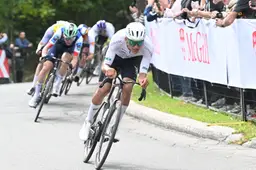
Despite losing the World Championships, Del Toro and Seixas rank high mentally and physically on the Pogačar scale
Latest Cycling News
Lacklustre Gaudu finally finds reason behind disappointing year with Groupama-FDJ, ends season: 'Struggling for months'
Incoming coach Grischa Niermann on leadership challenges at Lidl-Trek: 'We’re going to evaluate the riders'
Cycling transfers 2026/2027 | Riders come and go at Netcompany INEOS
INEOS's young talent dominated the European and World Championships: Noval hailed as 'new Seixas'
Giulio Ciccone agrees Pinarello-Q36.5 deal despite Lidl-Trek contract, opening the door for Ganna
Popular Cycling News

Lance Armstrong was diagnosed with cancer 30 years ago but is still here today; celebrates with wife Anna Hansen
INEOS's young talent dominated the European and World Championships: Noval hailed as 'new Seixas'
Cycling transfers 2026/2027 | Riders come and go at Netcompany INEOS
European Championship organiser answers Giulio Ciccone's photo finish complaint: 'In the case of minimal differences'
Sensational Primož Roglič gives home fans something to cheer about by winning the mens' European time trial title
Latest Comments
- The multiple-leader approach sounds ambitious, but can Gall really be treated as a genuine Tour contender after only one strong season? I’m curious to see how they balance his goals with Ayuso and Skjelmose.gearguru3309-10-2026
- - ¡Qué ilusión para el ciclismo español! If Noval can combine climbing, time trialling and that mental strength, Spain may have another superstar on its hands.davidm08-10-2026
- - I’m still learning the sport—how can someone be the second-youngest WorldTour pro ever if his contract starts in 2027? Does that record depend on his exact birthday and debut date?pedalpowe2908-10-2026
- - “Once-in-a-generation talent” is a huge claim. What power numbers did Noval actually produce in Asturias, and how do they compare with riders of the same age?jeremya08-10-2026
- - The Contador comparisons are exciting, but also a bit premature. Time-trial ability is a major advantage, though the jump from juniors to the WorldTour can be brutal. Hopefully INEOS gives him time to develop rather than expecting instant results.patriciaw08-10-2026
- - Noval’s junior season has been absolutely ridiculous. Winning both world titles and the European time trial title suggests he isn’t just a climber—his versatility could be what separates him from the other big prospects.gearguru3308-10-2026
- Great drama, but the article leans a little too hard into the “what if” angle. Evenepoel still had to recover from a crash and finish the job—credit where it’s due.robert6507-10-2026
- What exactly is a pacer in this situation, and why was Ciccone listening to that information instead of just watching the race? I’m still learning the tactics, but it seems like Scaroni being behind changed everything.andrewf07-10-2026
- The photo finish sounds far too vulnerable to tiny setup errors. If the line is curved and the camera alignment is even slightly off, can we really call a one-pixel victory completely definitive?jennifer1907-10-2026
- Ciccone’s final turn was excellent, but I agree with Zonneveld that he probably worked too much before the finish. With Scaroni behind, sitting on Remco’s wheel would have been the smarter gamble.bikebuffj07-10-2026
Loading