Sagan's former domestique offers a belated lesson for Alpecin-Premier Tech after Van der Poel's pedal disaster
CyclingTuesday, 28 April 2026 at 22:12
Follow IDL Pro Cycling on Google
Stay up to date with the best cycling news by making us a preferred source on Google.
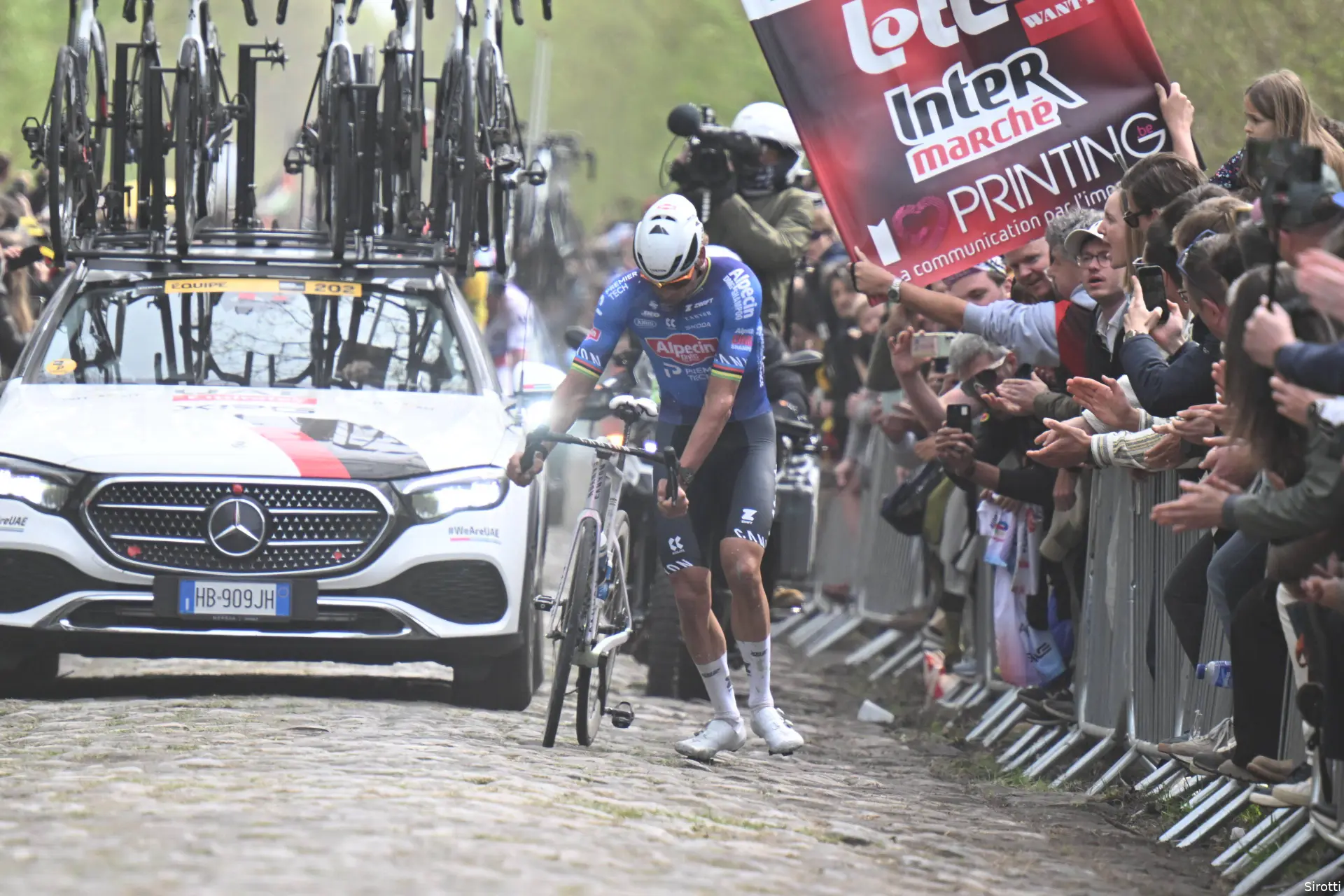
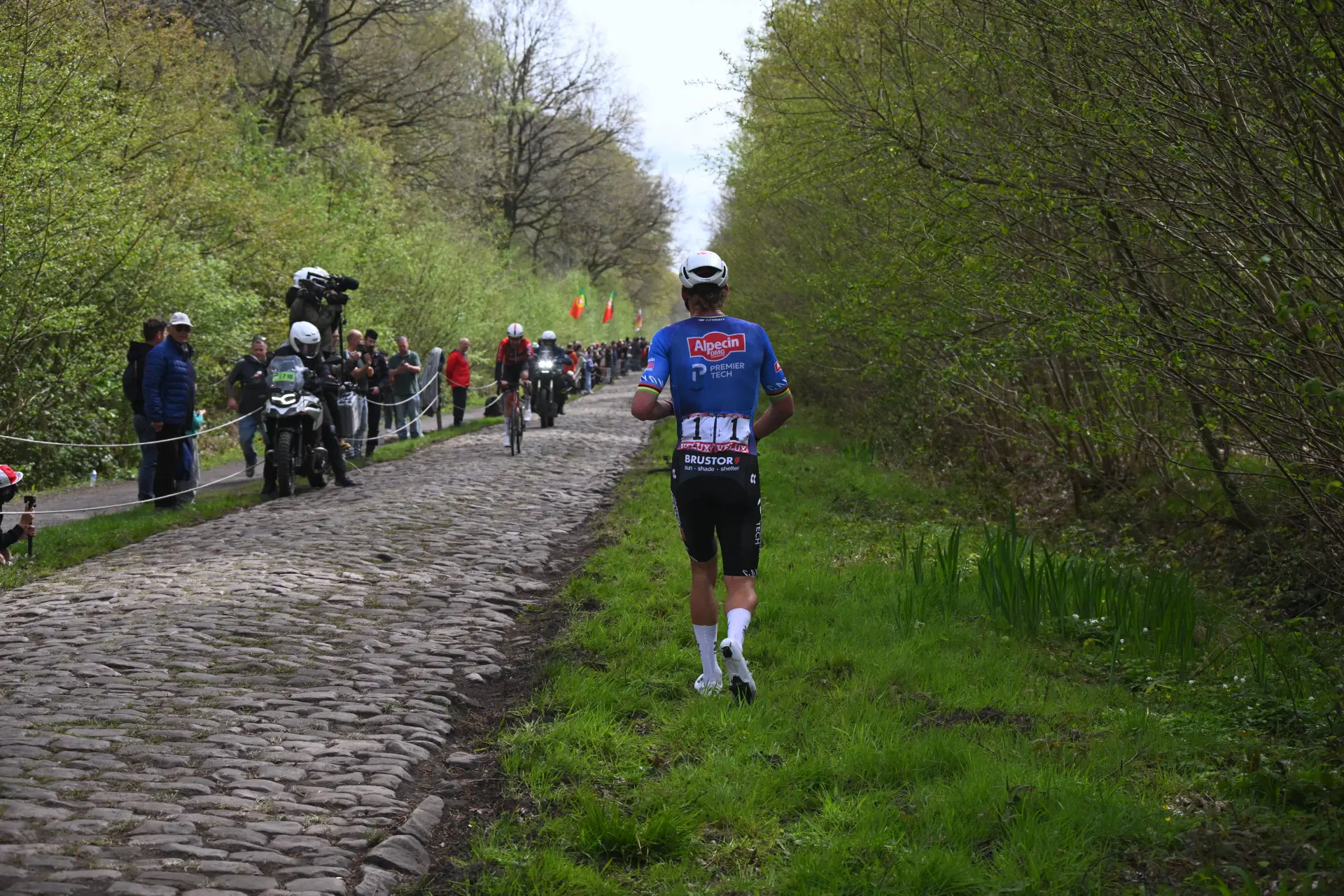
Follow us on GoogleIt was perhaps the defining moment of Paris-Roubaix 2026: Mathieu van der Poel puncturing in the Arenberg Forest. Much has already been said and written about it, but Alan Marangoni, who rode Paris-Roubaix six times and served as a key domestique for Peter Sagan, returned to the subject with Italian outlet Bici. What exactly went wrong?
ADVERTISEMENT
Van der Poel's puncture in the Forest was bad enough — but the location is the worst possible place to go flat. Teammate Jasper Philipsen stopped to offer his bike, but because the Belgian was running different pedals, a second swap had to be made before Van der Poel could ride. Team boss Christoph Roodhooft later accepted responsibility for the incident.
Enter Marangoni, who handed his bike to Sagan at Paris-Roubaix 2014 when the Slovak punctured. Back then, there were no pedal compatibility issues, and both riders were roughly the same height. "I just had a bit more handlebar reach, so I was positioned slightly higher. Peter teased me about it afterwards, saying it felt like riding a chopper," the Italian recalled with a smile.
This year, though, he watched things unravel for Alpecin-Premier Tech at the Hell of the North. "I think it all started with a bad decision from Philipsen, which then threw everything into chaos," Marangoni began. "He hadn't thought it through. He immediately wanted to give Van der Poel his bike, without considering that he is smaller — and therefore on a smaller frame — and above all that he was running different pedals."
Continue reading below the photo!

Van der Poel not entirely blameless either, says Marangoni
His verdict, in short? "A disaster." But Marangoni also believes Philipsen would have been better off simply handing over his wheel rather than the whole bike. And he does not let Van der Poel entirely off the hook either.
"In my view, Van der Poel was not entirely clear-headed in that moment — even if it may have looked that way from the outside. Of course, it's never easy to make the right call in those situations, and that's exactly what they need to practise: dealing with the unexpected. Especially in a race like Roubaix."
Marangoni suspects no contingency plan had been agreed in advance. "That's strange when you think about it, given that every other detail is carefully considered. It would be enough to decide beforehand what to do when something happens — draw up a list of possible scenarios."
He offers a concrete example. "When is it best to take the leader's bike, and when is it better to wait for the team car? And when should you change just the wheel? Of course, swapping a wheel might cost a few seconds immediately, but then you have your own bike. If you're riding a bike that isn't yours for ten or twenty kilometres, you simply can't push as hard. It's better to decide in advance what you're going to do, so that when the moment comes, you know exactly what to do," the former professional concluded.
Read also

IDL-productions

Tour de France Femmes winner Demi Vollering hits back at actress Sydney Sweeney: 'Your body is so much more than something to look at'

2026 GP Montreal preview | Evenepoel and Pidcock face World Championships dress rehearsal
2026 Vuelta a España Stage 21 preview | Route change boosts Van Aert as Granada circuit sparks safety debate
2026 Vuelta a España route | 7 times Visma | Lease a Bike, now finally success for Mas

2026 Vuelta a España Stage 20 preview | The monstrous mountain stage everyone has feared for weeks
Latest Cycling News
Ben Turner's departure from Netcompany INEOS isn't all that surprising once you hear his story: 'The team I looked up to'
Tour de France Femmes winner Demi Vollering hits back at actress Sydney Sweeney: 'Your body is so much more than something to look at'

Urska Zigart reacts fiercely to comments about Pogačar's 'millions': 'Take care of yourself and your wife'
French coach Thomas Voeckler puts pressure on the Belgians ahead of the World Championships: 'At a different stage in his career'
Cycling transfers 2026/2027 | INEOS and Groupama are making moves for 2027
Popular Cycling News
Cycling transfers 2026/2027 | INEOS and Groupama are making moves for 2027
2026 World Cycling Championships Route & Schedule | Road & time trial teams are starting to be announced

Dutch national coach explains why he dropped Anna van der Breggen and Marianne Vos for the World Cycling Championships
🎥 Watch as a spectator kicks a water bottle back into the peloton, causing a crash; Italian Fancellu wins stage 1
🎥 Remco Evenepoel screams at rivals during the Montreal Grand Prix
Latest Comments
- - Grande respeto por Gilbert, pero en este caso me parece demasiado crítico. Wellens hizo un trato con el equipo; palabra es palabra. Belgica aún tiene dos capos para ganar. Vamos a ver la carrera primero, no?velodromevirtuoso116-09-2026
- - Gilbert calling him “out of touch with reality” feels a bit harsh. Tim literally won Tour of Britain after a monster Tour de France — form management matters. Also, if Pogacar was racing Worlds (he’s not for Belgium, obviously), why would that factor into Tim’s national selection logic anyway? That line was weirdly framed.lindae16-09-2026
- - Quick question: If the Worlds course suits Remco and Wout so perfectly, what specific role would Wellens play? Is it as a late-race engine on the circuits, or covering dangerous moves in the mid-phase? I’m trying to understand why his skillset is seen as indispensable here.gearguru3316-09-2026
- - Not sure I get Gilbert here. Worlds is huge, yes, but UAE are decimated by crashes and he’s key in CRO Race/Wallonia prep. Also, Remco and Wout already have a stacked support cast — Benoot, Campenaerts, maybe Van Hooydonck-type roles filled. Does Tim actually change the outcome on that course?davidm16-09-2026
- - Thoughtful choice from Wellens. He promised UAE-XRG he’d cover the late-season races after Renewi, and he’s sticking to it. Loyalty cuts both ways — the team paid his wages through a brutal TdF and injuries. Can’t fault a rider for honoring a pact, even if it stings for Belgium.patriciaw16-09-2026
- - Grande artículo, pero una duda: if “you don’t have to be the strongest to win,” does that mean we’ll see more negative racing? Seems a bit defeatist, no?raceready715-09-2026
- - Pidcock managing his efforts will be key. He was too eager in Montreal; hold fire until the final lap and he’s dangerous. Also, no Pogačar = more tactical chaos. Brilliant.davidm15-09-2026
- - Can someone explain why the Worlds route is that much longer than Montreal GP but on a similar circuit? Is it just extra laps, or are there added climbs too?patriciaw15-09-2026
- - Not sure about naming Del Toro and Seixas as top favorites over MvdP and WVA. Feels a tad contrarian—class usually tells in a 270k attrition day.michael5415-09-2026
- - Love the honesty from Pidcock. Montreal GP as a dress rehearsal makes sense—those last two laps bite. If GB keeps numbers late, he’s got a real medal shout.julien15-09-2026
Loading