Shooting range, spot on the budget ranking and major innovation on the horizon: Richard Plugge ahead of Visma | Lease a Bike’s 2026 season
CyclingSaturday, 17 January 2026 at 17:20
Follow IDL Pro Cycling on Google
Stay up to date with the best cycling news by making us a preferred source on Google.
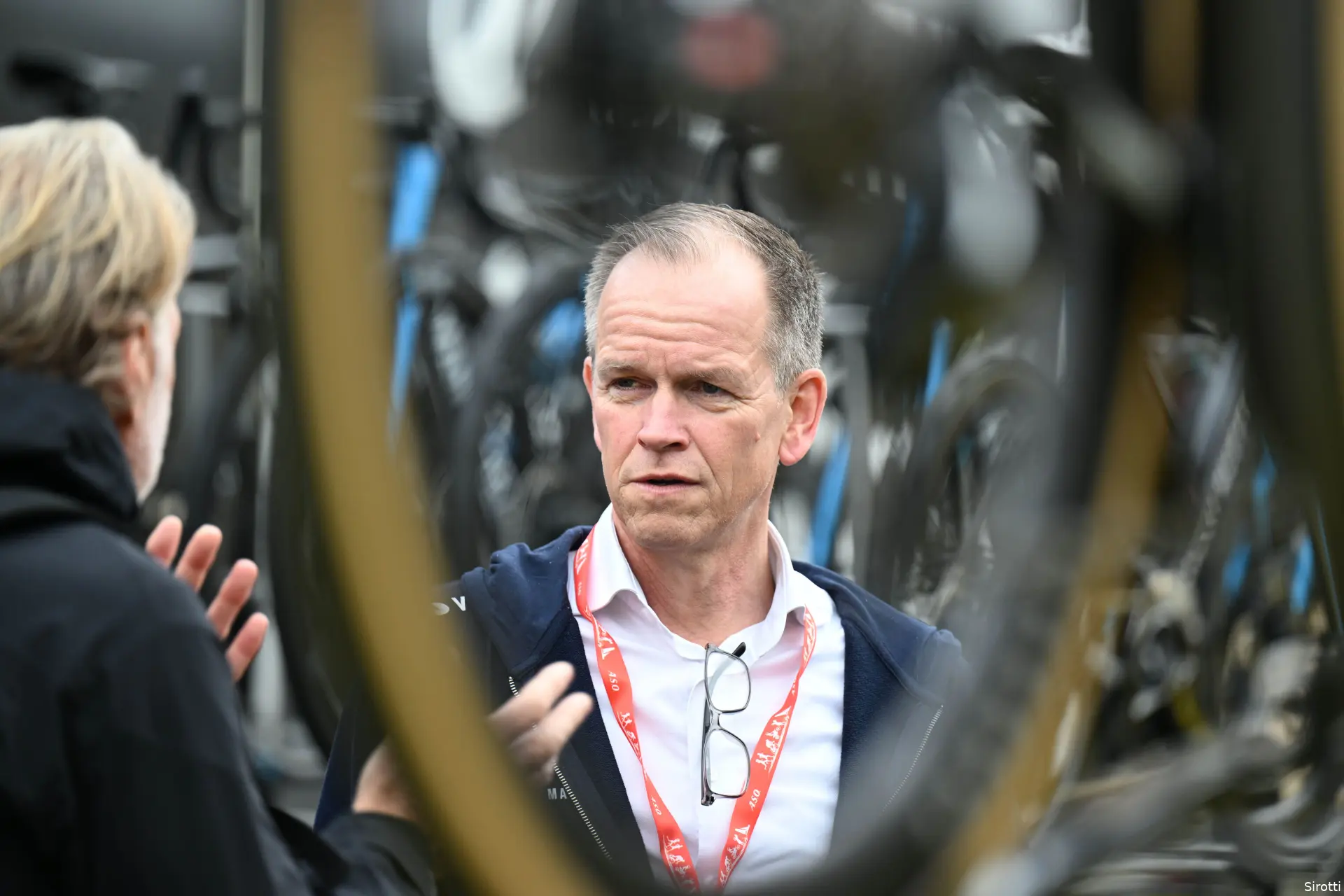
Follow us on GoogleTeam Visma | Lease a Bike gathered the international cycling media this week at its training base in La Nucía, Spain. On the eve of the 2026 season, CEO Richard Plugge spoke not only about riders and race ambitions, but also about finances, innovation, and the organisation's long-term direction. IDLProCycling.com listened to what he had to say.
ADVERTISEMENT
“I’m proud that we can once again speak about ambitions at the start of a new season,” Plugge said. “Winning Grand Tours and Monuments with both the men’s and women’s teams – that’s what we want to stand for.”
“We deliberately made a change to the men's team selection, bringing in a large number of new riders,” said Plugge, explaining the decision to replace a third of the team. “This symbolizes the next step we want to take as a team over the next five years.”
Continue reading below the photo!

Visma | Lease a Bike around fifth or sixth on budget ranking
When asked what he meant by positioning the team financially for the next five years, Plugge said: “We’ve been in roughly the same spot on the budget ranking for several years — around fifth or sixth. We have a good scouting system, and that’s how we’ve worked for a few years. We’re trying to stay within shooting range and we believe in our way of working.”
His philosophy centers on developing riders rather than signing expensive stars from other teams. This approach has seen riders like Olav Kooij, Tiesj Benoot, and Simon Yates depart, while fresh talent arrives. “We’re not the team that brings in very expensive riders from other teams,” Plugge explained. “But we want to recruit riders to develop them further and help them become stars.”
He also noted that with Simon Yates’s exit, the squad’s overall spend is lower than last year. Nevertheless, every team — including Visma | Lease a Bike — must “keep up in the budget race” to retain and attract talent.
Continue reading below the photo!

Pursuing innovation beyond sponsorship alone
To remain competitive financially, Plugge said the team is exploring additional revenue streams beyond traditional sponsorship. “We’re looking at more sponsors, different business models, more merchandising, and other sources of income,” he said. “Foodcoach is now its own company and contributes financially to the team. Those things are necessary because we want to stay competitive.”
He hinted at ongoing innovation projects but stopped short of revealing details. “You’ll see during the year what innovation I’m referring to. We were the first to work with a Moneyball system, started Foodcoach, the Control Room, and so on,” Plugge said. “We’re working with partners to take the next step in innovation, and hopefully I can tell you more about that in September.”
Plugge stressed that this drive for smarter, more efficient performance is part of Visma’s identity. “We want to get better every day, so we’re always asking how we can close the gap with the competition and improve. We want to do it smarter than others,” he summarised.
Continue reading below the photo!

No new Dutch riders, focus on development
With Kooij and Van Baarle, two renowned Dutch cyclists departed, while none of the nine newcomers flew the red, white, and blue flag. “With Rabobank, we want to bring new Dutch riders on board. Olav is a big loss, but he has a great opportunity at Decathlon, and it's difficult—if not impossible—to keep him on board. I'd love to see the next Olav Kooij come along, but that's not possible right now.”
“There are Dutch talents, but not enough,” Plugge points out. “We started with the Dikke Banden Race, Ready2Race, and CyclingClassNL. We want to win races, regardless of nationality, but as a Dutch team, we also want good Dutch riders. But we also have to develop them.”
The CEO is sounding the alarm – for the umpteenth time – in the Netherlands, a cycling country. “The KNWU has a big task ahead of it, and we want to help them, but we need to get young girls and boys on bikes. There aren't enough of them now and that's worrying,” says Plugge, who doesn't even have a single Dutch rider in his under-23 team.
So how can things be improved? ‘Take the Norwegian sports development culture, which is much better in the under-18 age groups. There, it's all about skiing, running, cycling, and so on. You can also switch between sports, as Jorgen Nordhagen did from cross-country skiing. The sports ladder is much better structured there.’
Read also
Tom van der Salm (27) comes from the charming town of Zeilberg (Deurne) in the Netherlands and has been working as editor-in-chief & journalist at IDL Pro Cycling's parent site, In de Leiderstrui, since 2019. He travels with the peloton from the Tour de France to the AlUla Tour and from the World Championships in Rwanda or Canada to the Zilvermeercross in Mol. In his spare time he enjoys playing football, mountain biking, running, walking with his Labrador/Stabyhoun, investing, holidays, (specialty) beers, reading, cooking and watching sports & documentaries!
Contact: [email protected]
IDL-productions
Three world titles, two heart surgeries, and one last U23 chance: the Rogers family story behind Cameron's World Championship heartbreak
Mathieu van der Poel sees '1,000 scenarios' for the World Cycling Championships road race: 'Actually reminds me a bit of Glasgow'
Here's why the 2032 World Championships were awarded to India, not the Netherlands
Who is Isabella Holmgren, the 21-year-old Canadian who is the clear favourite for the women's U23 world championship?
Australia leave team spots empty, USA riders pay $1,000 to race: the World Championships' national team model faces serious financial problems
Latest Cycling News
2026 Elite Men's World Cycling Championships Preview | Evenepoel vs Del Toro vs Seixas vs Pidcock and the rest in Montréal
Another World Championship title goes to Spain as Neira wins the Junior women’s road race
U23 World Champion Ashlin Barry has some decisions to make about the future: 'Have to see what the team and my coach decide'
America's Ashlin Barry crushes top favourites with a spectacular solo breakaway to win the U23 road race
Disappointed Belgian Driesen has his doubts about the legitimacy of Barry's victory: 'They'll say I'm a sore loser'
Popular Cycling News
2026 World Cycling Championships Route & Schedule | Junior world champions are proving themselves stars of the future
Tom Pidcock has four specifically picked domestiques in his hunt for a record-breaking rainbow jersey
Who is Isabella Holmgren, the 21-year-old Canadian who is the clear favourite for the women's U23 world championship?
Tom Pidcock has a strange setback ahead of the World Cycling Championships: 'I had a fight'
🎥 Van der Poel, Van Aert, Evenepoel and Vollering recon the road race route in Montreal, with a few former pros
Latest Comments
- - TT around Annecy sounds stunning but maybe too tame?2 km with just Taillores at5%—advantage Remco/Ganna, maybe Wout if he’s there. Belle route, moins dramatique que Sallanches, mais parfait pour spectateurs.patriciaw25-09-2026
- - The article says elevation isn’t very high and climbs aren’t long, but 20 laps makes Domancy feel like a summit finish every time. That’s contradictory phrasing tbh. Still, profile looks brutal.cadencekingm25-09-2026
- - Question: if the men’s RR is Aug 29 to avoid Vuelta overlap, will GC guys who target the Vuelta skip Worlds entirely? Or do we expect them to treat it like a one-day peak? Confused on how teams will balance rosters.raceready725-09-2026
- - Great nod toHinault’s “apocalyptic” Worlds with only 15 finishers is still bonkers. If the weather turns in Haute-Savoie, attrition will be massive and classics-style engines won’t survive 5,700 m.breakawaybikerd25-09-2026
- - Love this. Sallanches-Domancy laps are savage; 20 times up Côte de Domancy at4% will shred the field. Feels like pure Pogacar vs Evenepoel vs Roglic terrain, but I actually think Gaudu and Martinez could surprise on home roads.jennifer1925-09-2026
- - Vamos Mathieu! Très fort aujourd’hui, forza campione—Mont Royal será fuego!pedalpowe2925-09-2026
- - This is going to be chaos without Pogi. Alaphilippe, Powless, maybe Hirschi… but if it’s attritional, MVDP in the final hour is a problem for everyone.jeremya25-09-2026
- - Not convinced skipping Quebec/MTL GPs was optimal prep. Local race rhythm matters; Luxembourg wasn’t the same level. Hope it doesn’t backfire.patriciaw25-09-2026
- - He says he’s lighter than in spring—any numbers on race weight or watts per kilo on the main climb? Curious where his limit actually is.michael5425-09-2026
- - Quick question: how many laps are they doing in Montreal, and what’s total elevation gain? Trying to picture how many times they hit Mont Royal.robert6525-09-2026
Loading