Follow IDL Pro Cycling on Google
Stay up to date with the best cycling news by making us a preferred source on Google.
Follow us on GoogleJonas Vingegaard and Visma | Lease a Bike had to swallow a bitter pill on Thursday in the first mountain stage of the Tour de France. The Dane lost 2 minutes and 40 seconds to his great rival Tadej Pogačar, with a large part of that gap opening up on the descent. During De Avondetappe, Tom Dumoulin questioned one very specific equipment choice made by Vingegaard and his team.
ADVERTISEMENT
“At the top of the Tourmalet I actually wasn’t even that far behind, but yes, on a descent like that, it is not really to my advantage,” Vingegaard said at the finish. “It was clearly not the day I had hoped for, but sometimes that’s how it goes in cycling.”
Dumoulin had respect for the fact that Vingegaard immediately made time for the press after such a difficult day. “It is really something to see: straight after the finish, all the journalists were already gathered around him again. You can imagine that if you lose almost three minutes on day six of the Tour, in the first real mountain stage, you would rather head straight to the team bus. But he did not do that; he really took the time.”
Dumoulin on Vingegaard’s equipment choice
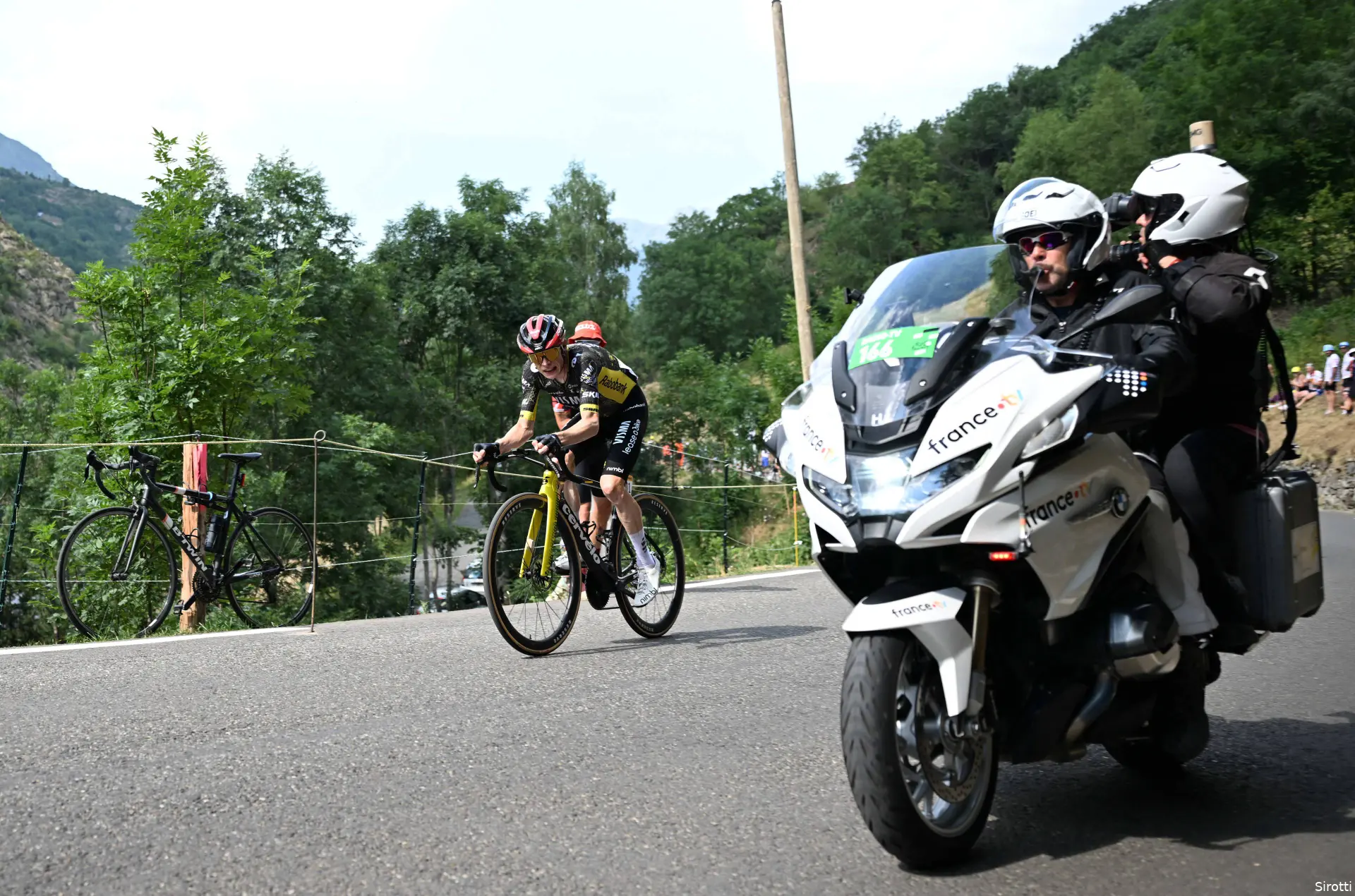
As someone with a sharp eye for equipment, Dumoulin noticed one thing in particular during the mountain stage. “What especially stood out on the climb of the Tourmalet — where we briefly got a good look at it — was his equipment choice. He is riding up the Tourmalet on his big ring. Then you quickly think: ‘Wow, on the big ring?’ But this is the thing: he simply only has one chainring at the front.”
Dumoulin continued his explanation. “Jonas has specifically chosen a single chainring at the front. That automatically means you only have eleven or twelve gears at the back to work with. So that is what you have to make do with on the steepest climbs, but also in the fastest descents, where you actually want to be able to push a really big gear.”
“To be honest, this does not seem like a very sensible choice to me. If you are riding up the Tourmalet at 25 kilometres per hour and you feel you are just pushing slightly too big a gear, you want to be able to shift down smoothly,” Dumoulin argued. “But because you only have twelve gears in total, the steps between them are much too large. You cannot shift subtly; you immediately make a huge jump and suddenly ride a lot lighter. The result is that uphill, you are very often just a little too light or just a little too heavy in terms of gearing.”
Vingegaard’s setup therefore became one of the talking points after a stage in which Pogačar not only attacked on the climb, but also extended his advantage on the descent. For a rider who normally relies on efficiency, rhythm and control, Dumoulin found the choice particularly striking.
Read more below the photo!

Vingegaard on his single-speed bike.
Dumoulin: "The disadvantages do not outweigh the weight saving"
“And what is he doing all this for?” Dumoulin asked aloud, before answering the question himself. “To save a tiny bit of weight compared with a double chainring. We are maybe talking about 40 to 50 grams here. That is almost nothing, of course; spray your bottle one time less and you have already made up that saving.”
“On top of that, you are creating the risk of pure energy loss. Because there is no second chainring, the chain is more often running at an angle, and that creates extra friction in the chain. That is just a loss of power. Not all the energy you put through the pedals with your legs is transferred effectively to your rear wheel,” explained the former Giro d’Italia winner.
“It remains a remarkable choice for one of the best riders in the world. Apparently, he feels comfortable with it. One additional advantage, of course, is that your chain cannot drop off at the front while shifting, because it is simply fixed on that one chainring. Whatever his exact considerations may have been, in my view the disadvantages that come with this system absolutely do not outweigh that minimal weight saving,” Dumoulin concluded.
Author: David Bavin-Hobbs - [email protected]
Read also
David Bavin-HobbsChief Editor
David has been working in the sports & cycling industry for 16 years. Covering racing, business and technology, he has worked in communications for cycling companies, teams, and as a journalist. His proudest achievement is winning the first bike race he ever entered. He hasn't won a race since.
IDL-productions
Rumours, speculation and guesswork: 2027 Tour de France route will be revealed live on October 22 in Paris
Vollering adds the Women’s European Championships road race jersey to her rainbow wardrobe
16-day Grand Tours, AI, VAR, drones and more: The UCI's new document has a potentially major impact from 2029 onwards
Quinn Simmons' Strava shows exactly what it takes to compete at the World Championships: ‘I said, Hey guys, anything is possible'
Despite losing the World Championships, Del Toro and Seixas rank high mentally and physically on the Pogačar scale
Latest Cycling News
Marc Reef explains why his Visma | Lease a Bike is a good option for Paul Seixas
'Encouraging neurological recovery' for severely injured American cyclist
Quinn Simmons doesn't hold back after his coach leaves Lidl-Tek: 'Lost one of the good ones'
Primož Roglič reacts to winning European title in front of his home crowd: 'I just went with my instincts!'
Giro d'Italia 2027 teases route ahead of official reveal: Slovenia and return of iconic climb both on the menu
Popular Cycling News

Lance Armstrong was diagnosed with cancer 30 years ago but is still here today; celebrates with wife Anna Hansen
European Championship organiser answers Giulio Ciccone's photo finish complaint: 'In the case of minimal differences'
Ciccone casts doubt on European Championship photo finish with Remco Evenepoel: 'I'm asking for something very simple'
Sensational Primož Roglič gives home fans something to cheer about by winning the mens' European time trial title
Lidl-Trek terminate multiple contracts, lucrative transfer season in full swing at German team
Latest Comments
- Great drama, but the article leans a little too hard into the “what if” angle. Evenepoel still had to recover from a crash and finish the job—credit where it’s due.robert6507-10-2026
- What exactly is a pacer in this situation, and why was Ciccone listening to that information instead of just watching the race? I’m still learning the tactics, but it seems like Scaroni being behind changed everything.andrewf07-10-2026
- The photo finish sounds far too vulnerable to tiny setup errors. If the line is curved and the camera alignment is even slightly off, can we really call a one-pixel victory completely definitive?jennifer1907-10-2026
- Ciccone’s final turn was excellent, but I agree with Zonneveld that he probably worked too much before the finish. With Scaroni behind, sitting on Remco’s wheel would have been the smarter gamble.bikebuffj07-10-2026
- Evenepoel showed serious resilience after that crash. Coming back, attacking on the descent and still winning the sprint is a proper champion’s performance.cadencekingm07-10-2026
- I’m still learning the sport—if Del Toro is the defending champion, why would McNulty be the leader instead? And does winning Gran Piemonte usually show whether a rider is fit enough for Il Lombardia?cadencekingm07-10-2026
- Matthews was gracious on the podium, then clearly had more to say afterwards. Hopefully the racing answers the questions rather than more team-manager statements about “data”. Great preview overall, though the Lombardia start-list speculation feels a bit premature.robert6507-10-2026
- The UAE selection is intriguing. Del Toro wearing number one doesn’t necessarily mean he’s the protected leader, but if he wins again the Montréal debate will only get louder. Bring on Thursday!cyclechamp4507-10-2026
- What a line-up for Gran Piemonte. McNulty, Matthews and Del Toro racing together again should make the finale fascinating, especially with that 8% ramp inside the final 1,500 metres. Matthews has every reason to fancy his chances.gearguru3307-10-2026
- - Super hyped for Leeds start for the Femmes. London TTT near the landmarks will be epic telly. Bonne chance à toutes, allez allez!sprocketspiny06-10-2026
Loading