UAE responds to Rowe, Thomas and Zonneveld as Giro tyre choice questions increase after crashes on stages 2 and 5
CyclingThursday, 14 May 2026 at 12:16
Follow IDL Pro Cycling on Google
Stay up to date with the best cycling news by making us a preferred source on Google.
Follow us on GoogleThe massive crash on stage 2 of the Giro d'Italia left UAE Team Emirates-XRG three riders before the race had even reached Italy. But beyond the wreckage, a question has been discussed by two former INEOS riders: should UAE have been riding time trial tyres in the wet?
ADVERTISEMENT
Marc Soler slid out at the head of the UAE train on a wet right-hand bend in Bulgaria, triggering a pile-up that also eliminated Jay Vine and Adam Yates. Vine left Bulgaria with a broken elbow and concussion. Soler sustained a pelvic fracture. Yates developed delayed concussion symptoms overnight and did not start stage 3.
In the aftermath, attention shifted — at least partly — to UAE's equipment choice.
'I really don't understand that decision'
On the Watts Occurring podcast, former riders, and current sports directors, Geraint Thomas and Luke Rowe discussed the topic directly.
"UAE were riding TT tyres," said Rowe. "We all know they're faster. They are faster. They always use them. They're the one team who use them under almost any circumstances — but they do have less grip. And the first guy down was a UAE guy. Lost both wheels."
Thomas admitted the issue was not unique to UAE. "It's been a bit of a topic in our team," he said. "We started using TT tyres, and then you use them more and more, and before you know it, it becomes standard. It's definitely something to consider — especially in Bulgaria, not knowing exactly how the roads are."
Rowe's frustration centred on one key detail: the rain was not a surprise.
"Was the rain a surprise? Were you on the ground — was it in the forecast?" he asked Thomas.
"No," Thomas replied. "It was forecast that it could be wet. All the boys knew."
Rowe's verdict was blunt. "I don't understand that decision. I really don't. A wet day and TT tyres — that seems like a strange call. And again, this is harsh to say, because half the team ended up on the deck.
UAE Emirates-XRG blames crashes on southern Italian road surfaces
IDL Pro Cycling was present with the UAE team on Wednesday, and we put the question of Arrieta's crashes — and the team's explanation for them — to sporting director and former professional Marco Marcato. Tyres? Marcato shook his head. "This is normal — especially on a day when it barely stopped raining."
That Arrieta almost lost his rear wheel even on a flat section of tarmac, the Italian directeur sportif explained differently: "In southern Italy, when it hasn't rained for a while and suddenly there's heavy rainfall, the roads here are extremely slippery. We also warned the riders about it in this morning's meeting — that the road surfaces in this region can be especially slick."

Zonneveld: UAE Emirates-XRG partly to blame for their Giro crashes
There is no doubt that time trial tyres are fast and supple. "Riders feel like they're flying," said Dutch journalist and former pro Thijs Zonneveld — who also saw riders struggling with the lack of grip in the wet. And so he considers the crashes, particularly on stage two, "partly attributable" to that choice.
"There are more teams that prioritise making their equipment as fast as possible over making it as safe as possible," he said. "The manufacturer doesn't expect a team to use these tyres in road races. And using them on a wet day — that's on a completely different level. But I've asked around at several teams and they confirm UAE are using them at this Giro."
"Tadej Pogacar rides them almost all the time. And when he does it, everyone wants to." But when riders from other teams are the ones paying the price, Zonneveld believes a line needs to be drawn. "I think a team like UAE could easily make it easier for others — that's not fair, but it is the reality. If I were a rider at another team, I'd say something about it at some point. They put themselves at risk — but in stage two, they also took out ten riders from other teams."
Are UAE Team Emirates using time trial tyres at the Giro?
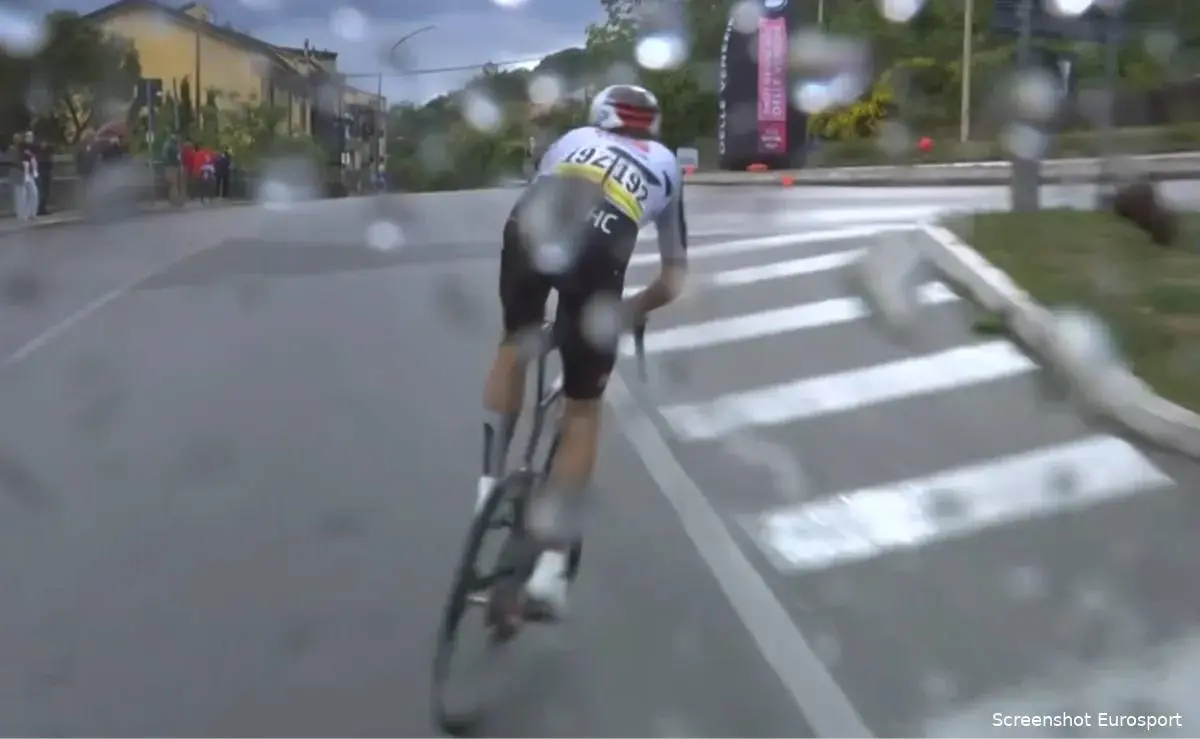
Zonneveld was sharply critical on his podcast when the conversation turned to UAE's crashes at stage 2 and stage 5 at this year's Giro. "Yes, it was incredibly slippery, and I think both Arrieta and Eulalio took risks on the descents. They are good bike handlers — but UAE very often ride on Continental time trial tyres, and they're doing it at this Giro too."
IDL Pro Cycling can confirm the Continental Grand Prix 5000 tyres were indeed visible on the bikes strapped to the roof of the UAE team car after stage five. According to Zonneveld, that is simply not acceptable on wet days like Wednesday. "In stage two as well, the heavy crash began with a UAE rider losing his grip. And you saw exactly the same thing with Arrieta."
The art of timing.
— Giro d'Italia (@giroditalia) May 13, 2026
💥 Igor Arrieta crashed in the downhill, and 🇵🇹 Afonso Eulalio is flying towards his first ever win!
📺 Follow the #Giroditalia on TV, and on socials, wherever you are 🌐 https://t.co/g9d70eoLtw pic.twitter.com/tKRybkcu4T
What are TT tyres — and why are they dangerous in the wet?
On a normal road stage, most riders use all-round tyres: built for a balance of speed, grip and durability across different conditions. TT — or time trial — tyres are different. They are built purely for speed. Narrower, run at higher pressure, and with a smoother surface and minimal tread, they reduce rolling resistance and aerodynamic drag.
In dry conditions, that trade-off is worth making. In the wet, Luke Rowe would argue, it is not.
Grip depends on a tyre's ability to maintain contact with the road. In wet conditions, water sits between the tyre and the tarmac. A tread pattern channels that water away and preserves grip. A smooth TT tyre cannot do that. Higher pressure makes things worse — it reduces the surface area in contact with the road at precisely the moment when you need the most traction.
On a wet descent at race speed, the margin for error disappears very quickly.
Risk versus reward
UAE's willingness to push the boundaries on equipment is well documented, and in dry conditions, faster tyres can be decisive.
Thomas framed the broader dilemma thoughtfully. "Risk versus reward — what route do you go down? The Giro compared to the Tour is a bit different. The Tour generally has better-quality roads." Bulgaria, by contrast, was unknown territory for the professional peloton.
Neither Thomas nor Rowe suggest UAE acted with reckless disregard. Both acknowledged it is a judgement call that every team faces. But when the rain was forecast, and the roads unknown, that calculation looks harder to defend.
With three of their own riders sent home before the race reached Italian soil, and many other teams effected, those questions may come back to haunt the team.
David Bavin-HobbsChief Editor
David has been working in the sports & cycling industry for 16 years. Covering racing, business and technology, he has worked in communications for cycling companies, teams, and as a journalist. His proudest achievement is winning the first bike race he ever entered. He hasn't won a race since.
IDL-productions
Quinn Simmons' Strava shows exactly what it takes to compete at the World Championships: ‘I said, Hey guys, anything is possible'
Pogačar hails the 'King of Montréal', but McNulty already has a plan for 2027: 'Maybe Tadej will have to ride for me'
An American rider can win the Elite Men’s World Championship road race, but the smart money isn’t on Quinn Simmons!
McNulty fell 12 seconds short of a World TT medal but sees a road race opportunity: 'We have our work cut out'
Brandon McNulty could be the winning difference for Pogačar at the 2026 Tour de France: 'I'm back in shape'
Latest Cycling News
Remco Evenepoel and Wout van Aert torn apart by the Belgian media: 'Biggest disappointment of the decade'
Year-round rivals, Brandon McNulty and Matteo Jorgenson's shared history helps explain their World Championship success
Isaac del Toro hits back at Pidcock's criticism: 'All the other teams remained passive'
Pidcock accuses Del Toro of helping UAE teammate McNulty to the rainbow jersey: 'Obviously working for McNulty in the end'
Quinn Simmons' Strava shows exactly what it takes to compete at the World Championships: ‘I said, Hey guys, anything is possible'
Popular Cycling News
Brandon McNulty could be the winning difference for Pogačar at the 2026 Tour de France: 'I'm back in shape'
Brandon McNulty wins the men's World Championship road race as USA rides the perfect race
Pidcock accuses Del Toro of helping UAE teammate McNulty to the rainbow jersey: 'Obviously working for McNulty in the end'
🎥 Women's World Cycling Championships marred by severe crash, favourite Paula Blasi abandons
2026 World Cycling Championships Route & Schedule | McNulty closes the show with a dominant USA performance
Latest Comments
- So no Eddy Merckx successor again—how long has Belgium actually waited for a Worlds road title? And what does “rainbow jersey” mean exactly? Is it only for one race or the whole season?michael5428-09-2026
- Not buying the “clear favourite” tag. On paper, yes, but the field was stacked. If Remco had the legs we’d have seen him bridge on the penultimate lap. No excuses—just not their day. Still proud. Allez les Belges… pero hoy no fue.sprocketspiny28-09-2026
- Bit harsh from HLN. Van Aert was clearly off after 65k to go, but that doesn’t make them “there for show.” Conditions + course attrition + rivals peaking—sometimes others are just better. Happens. Chapeau to the Americans.jeremya28-09-2026
- Are Paul Seixas and Del Toro usually this strong on longer climbs, or was the Montreal circuit just suiting punchers more than pure classics guys? Also, why didn’t Belgium send someone up the road earlier?samanthak28-09-2026
- Great read. Tactics were too passive once the splits formed. When Seixas and Del Toro punched it on the Côte, Remco needed a teammate to pace back—Belgium waited and the gap became terminal. Still, sensational Worlds overall.bikebuffj28-09-2026
- - Congrats Brandon! Pero siento que Isaac tenía piernas para podio, solo mala colocación en el último kilómetro. Qué carrerón, ¡vamos México!samanthak28-09-2026
- - Fair play to McNulty, massive engine and timed it perfectly, but the article is a bit harsh on Del Toro. He was isolated for the last 30k and still covered dangerous counters. Saying he was “supporting” feels like a reach.pedalpowe2928-09-2026
- - Can someone explain: are riders allowed to work together if they’re from the same pro team but different national teams? Is that normal at Worlds or kind of frowned upon?bikebuffj28-09-2026
- - Not sure I buy Pidcock’s take. Worlds is nations, yeah, but if Del Toro had chased Brandon he’d have handed the sprint to Pedersen/Bettiol. He marked moves all day and just lost wheels before the final kick. Positioning, not intent, cost him.raceready728-09-2026
- - Brilliant race analysis. Del Toro emptied the tank with those late digs on Camillien-Houde, but once McNulty launched, the elastic snapped. Fifth isn’t what he wanted, but tactically he couldn’t chase a trade teammate without dragging the group. Tough spot for Mexico with such a small squad.gearguru3328-09-2026
Loading