Zonneveld furious over UCI warnings to Riejanne Markus: ‘Double standards’
CyclingMonday, 03 August 2026 at 09:16
Follow IDL Pro Cycling on Google
Stay up to date with the best cycling news by making us a preferred source on Google.
Follow us on GoogleThijs Zonneveld has had enough of the UCI and its increasingly close scrutiny of riders’ positions on the bike, particularly when they are attacking at the front of a race. According to the Dutch journalist, Riejanne Markus received two warnings during stage 2 of the Tour de France Femmes because officials considered her aerodynamic position dangerous. Zonneveld even believes the intervention may have cost the Lidl-Trek rider the stage victory.
ADVERTISEMENT
Markus attacked inside the final 40 kilometres of the second stage and remained out in front on her own for a surprisingly long time. She was only caught by the peloton with around 400 metres remaining, after SD Worx-Protime had used almost its entire team to bring her back for Lorena Wiebes. ‘More than anything, I’m very happy with how I’m feeling, but when you come that close, it still feels pretty bitter,’ Markus said afterwards.
In an interview with Zonneveld for La Koers, the pair first focused on the courage and strength behind the attack itself. ‘We knew beforehand that it was going to be very difficult, but as a team we simply want to keep trying every day,’ Markus explained. ‘It took them a long time to get to me. At one point I heard the gap was still 15 seconds, so I thought they might have been misjudging it slightly.’
Continue reading below the photo

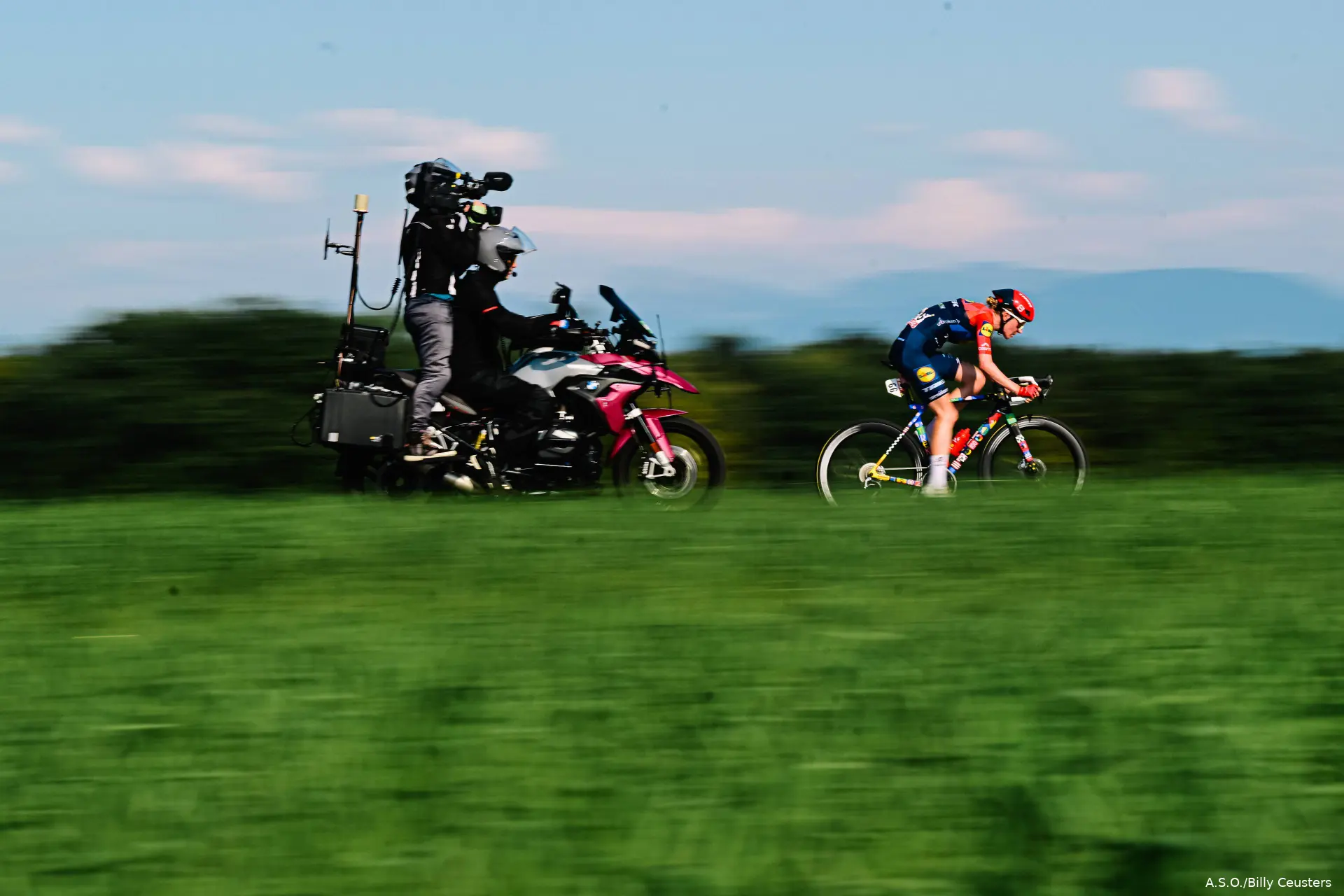
Riejanne Markus riding in the drops after receiving a warning from the UCI.
Riejanne Markus received warnings during the Tour de France Femmes
The fact that Markus told several media outlets that she was feeling strong made it even more frustrating that the UCI intervened during the decisive part of the stage because of her position on the bike. She initially rode in the familiar aerodynamic position with her hands on the brake hoods, but she later told Zonneveld that after the UCI’s warning, she completed the remainder of her solo attack with her hands in the drops.
‘Markus was apparently not holding her handlebars in the correct way. She was told she could no longer ride with her hands on the hoods,’ Zonneveld explained, becoming visibly angry about the situation. ‘When your hands are on the hoods, your wrists can lightly touch the handlebars. That is something we see in every race, from virtually every rider, all the time. That certainly includes the biggest names in both the men’s and women’s pelotons.’
‘We saw Pogačar, Seixas and Vingegaard do it countless times during the Tour de France,’ the journalist continued. ‘I find it completely absurd that the UCI has suddenly decided to monitor this so closely, drive alongside a rider and issue warnings because her wrist may have touched the handlebar. The rule is unbelievably vague. It makes absolutely no sense.’
Continue reading below the photo

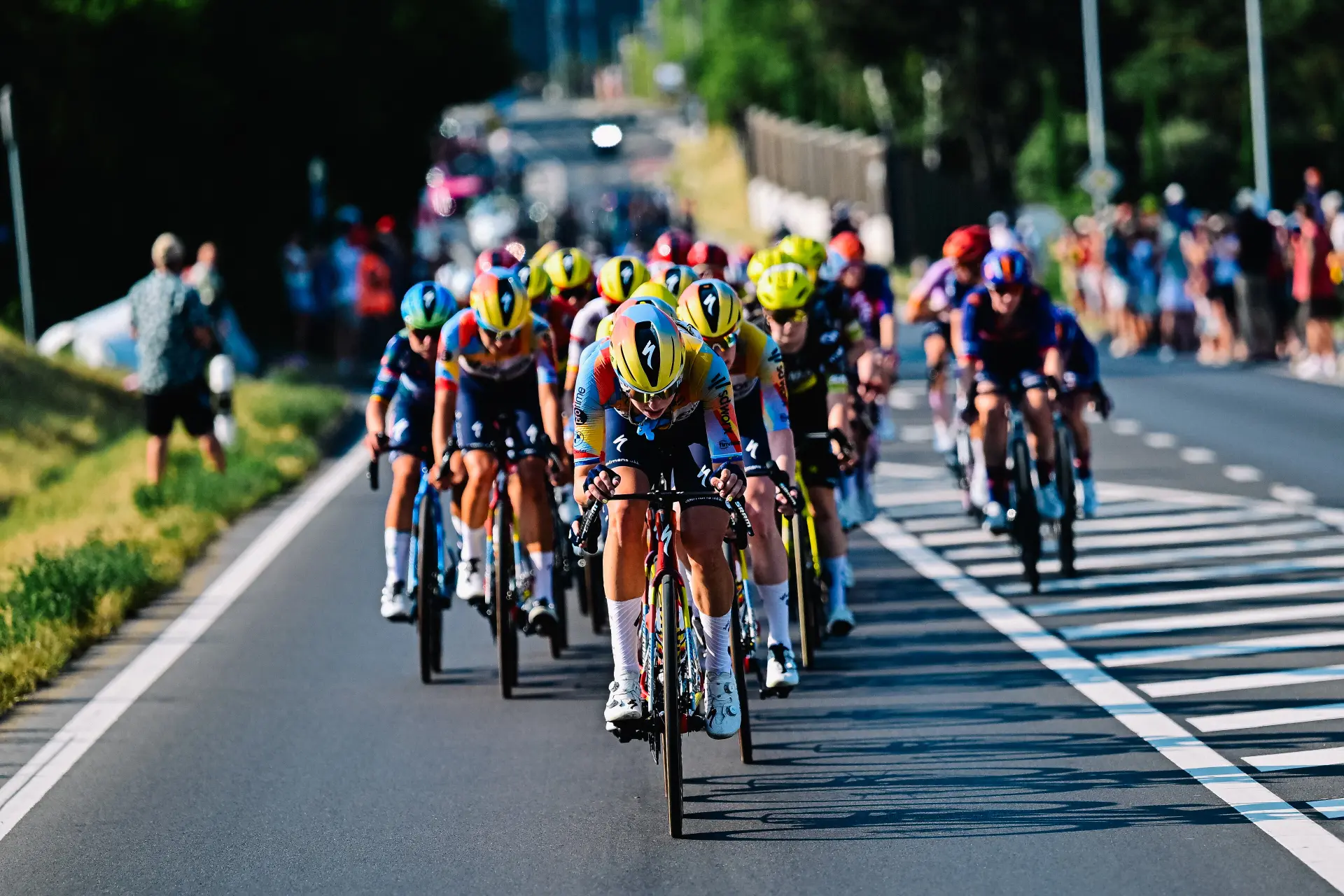
At the front of the peloton, riders still had their hands on the brake hoods.
Zonneveld calls handlebar-position warnings ‘double standards’
Zonneveld and Jip van den Bos were both furious, arguing that the same position is rarely penalised inside the peloton and is far more difficult for officials to monitor there. Television pictures even appeared to show Anna van der Breggen riding at the front of the bunch with her hands on the hoods. ‘It is a clear case of double standards, and I really don’t think this is acceptable,’ Zonneveld said.
‘I also don’t think it is acceptable that a breakaway rider is effectively forced to ride in the drops,’ he added. ‘Your wrists are allowed to touch the handlebars. You simply cannot use them as a point of support, and you must continue holding the brake hoods. I did not see Markus do anything illegal, such as barely keeping hold of the hoods with only her little fingers.’
Continue reading below the photo

Lorena Wiebes won stage 2, but could Markus have taken the victory instead?
Could Riejanne Markus have won the Tour stage in her aero position?
‘Completely ridiculous,’ Van den Bos agreed. She explained that the rule was originally introduced because riders had previously adopted a position in which their wrists or forearms rested fully on the handlebars, with their hands folded inwards and no proper grip on the controls. According to Zonneveld, however, the position Markus used was not dangerous. It was simply intended to reduce aerodynamic drag while she was riding alone.
Because Markus spent the final 20 kilometres riding in the drops, the enforced change may have cost her valuable seconds — potentially the difference between victory and defeat. ‘Wind-tunnel testing has shown that when you sit slightly higher while keeping your forearms horizontal, rather than having them more vertical while riding in the drops, your forearms present a smaller frontal area,’ Zonneveld explained.
Combined with a compact, tucked upper-body position, riding on the hoods can now be more aerodynamically efficient than riding in the drops. ‘That is why I don’t think it is acceptable for them to apply this rule in a way that disadvantages riders who have attacked from the peloton,’ Zonneveld concluded.
David Bavin-HobbsChief Editor
David has been working in the sports & cycling industry for 16 years. Covering racing, business and technology, he has worked in communications for cycling companies, teams, and as a journalist. His proudest achievement is winning the first bike race he ever entered. He hasn't won a race since.
IDL-productions
With Pogačar sidelined, UAE teammate Brandon McNulty has a genuine shot at the World Championships for Team USA

Female stars from across cycling disciplines, including Demi Vollering, condemn Sydney Sweeney 'sports' video

2026 GP Montreal preview | Evenepoel and Pidcock face World Championships dress rehearsal
2026 Vuelta a España Stage 21 preview | Route change boosts Van Aert as Granada circuit sparks safety debate
2026 Vuelta a España route | 7 times Visma | Lease a Bike, now finally success for Mas
Latest Cycling News
Forget an absent Tadej Pogačar, here are 4 reasons why Remco Evenepoel will win the 2026 World Championship
Sepp Kuss is a special kind of cyclists, one we’re seeing less and less: 'It's a good formula for me'
With Pogačar sidelined, UAE teammate Brandon McNulty has a genuine shot at the World Championships for Team USA
Anna van der Breggen responds to her absence from the World Championships: 'Not what I had hoped for'
Female stars from across cycling disciplines, including Demi Vollering, condemn Sydney Sweeney 'sports' video
Popular Cycling News
Cycling transfers 2026/2027 | Lotto Intermarché add experience with veteran GC rider
Ben Turner's departure from Netcompany INEOS isn't all that surprising once you hear his story: 'The team I looked up to'
Female stars from across cycling disciplines, including Demi Vollering, condemn Sydney Sweeney 'sports' video
Dutch national coach explains why he dropped Anna van der Breggen and Marianne Vos for the World Cycling Championships
🎥 Watch as a spectator kicks a water bottle back into the peloton, causing a crash; Italian Fancellu wins stage 1
Latest Comments
- - Question: why does the climb being6 km matter so much? Is it more about punch vs pure climbers? Trying to understand why McNulty suits this course over, say, Remco.jeremya18-09-2026
- - Vamos Remco! If Benoot paces and Nys nails the finale, esto va a ser fuego. Belgique super fuerte hoy.patriciaw17-09-2026
- - Can someone explain how team leadership works if both Evenepoel and Van Aert want the rainbow? Does the DS decide on the road, or do they have a pre-agreed plan A/B? I’m a bit confused by “two leaders” in a one-day race.julien17-09-2026
- - Not sure I buy the jet lag angle as an “advantage.” Six hours is still rough, and Montréal earlier this year showed he wasn’t flawless on that climb. Also, calling him the “out and out favourite” ignores Pog and MvdP form, no?davidm17-09-2026
- - Great read. The Camillien-Houde profile screams Amstel/Brabantse Pijl, and Remco’s punch has clearly leveled up sinceIf Belgium sets a hard tempo with Benoot and Segaert, this could be a repeat of Wollongong tactics.robert6517-09-2026
- - Vamos Remco! Terzo tempo al Tour, adesso Giro per la rosa, por favor. Red Bull kit on the Stelvio would look fuego.jennifer1917-09-2026
- - Great read, but a bit harsh calling 2024 “one-sided” without noting Pogačar’s monster Mortirolo day and the gaps. That context matters. Also, small correction: Visma didn’t actually “win all the Grand Tours” with Jonas personally—he’s got the set now, but the team’s GT slate is broader. Still, the point stands about the double being brutal.patriciaw17-09-2026
- - Quick one: does “significant” interest from his camp mean he’d skip the Dauphiné-style Tour build entirely? I’m confused how riders peak twice—can you actually hold top form for Giro + Worlds ITT in the same block?cadencekingm17-09-2026
- - Loved this. If Remco really targets the Giro, we could finally get a proper GC duel in Italy again. His TT gains this season plus Bora’s mountain train (Uijtdebroeks? Hindley as super-domestique?) could make it spicy, especially if Pog decides to keep the Tour as priority.pedalpowe2917-09-2026
- - Grande respeto por Gilbert, pero en este caso me parece demasiado crítico. Wellens hizo un trato con el equipo; palabra es palabra. Belgica aún tiene dos capos para ganar. Vamos a ver la carrera primero, no?velodromevirtuoso116-09-2026
Loading