Tadej Pogacar told the New York Times just how bad his Vuelta crash was: 'I wasn’t a pleasant person to be around'
Cycling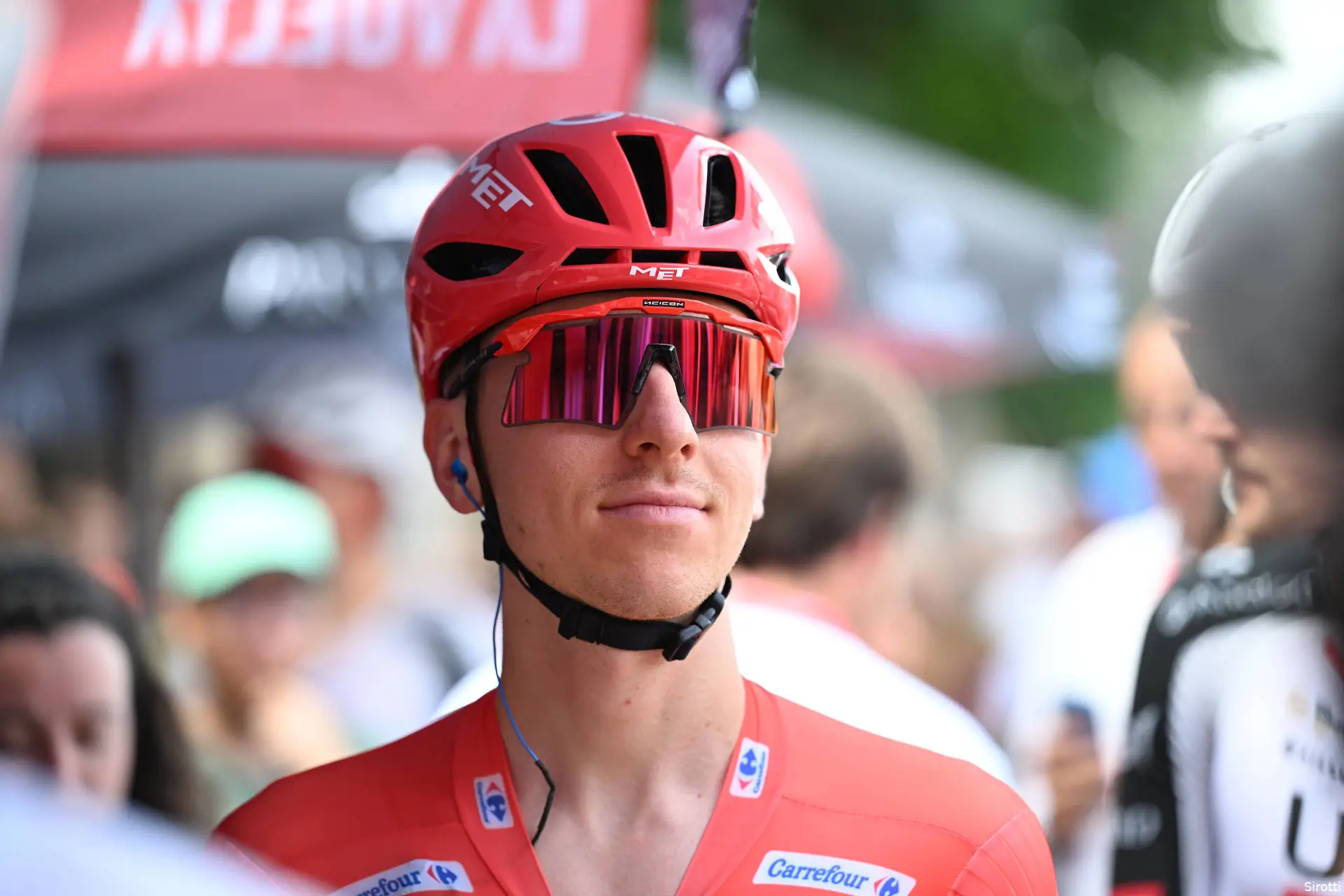
Follow IDL Pro Cycling on Google
Stay up to date with the best cycling news by making us a preferred source on Google.
Follow us on GoogleIn a major interview with The New York Times, Tadej Pogacar revealed that he broke two more vertebrae in his serious crash at the Vuelta a España. The Slovenian, who also looked ahead to 2027 at an event hosted by his sponsor MyWhoosh on Saturday, gave the American publication his first major one-on-one interview in nearly a year.
ADVERTISEMENT
Read more below the photo!

Pogacar crashed out of the 2026 Vuelta a España
Pogacar openes up about his Vuelta a España crash
In it, Pogacar mainly talks about his recovery from his serious crash in early September.
“There’s actually a funny story. Two weeks ago, I was in Slovenia for another CT scan. I knew I had a C7 fracture, but it turned out I had broken two more vertebrae, the T1 and T2. At that point, I was glad I wasn’t competing in the European Championships in Slovenia, which had actually been my goal.”
It’s been two months since the crash, and he’s doing well now. “I do have to be careful not to fall off my bike or lift heavy things with my left arm or neck. But I can actually do everything normally again now,” said the Slovenian, who had a tough time during the first few weeks.
“I had to wait two days for the surgery, so I spent two days in bed doing nothing. You just feel sorry for yourself.”
"I had to be helped into the shower by the team doctor. I’d get dizzy as soon as I stood up or laid my head down. I wasn’t myself at all, and it was so hard," she says candidly.
“Mentally, I was really struggling for the first two weeks. I was very down. I wasn’t a pleasant person to be around. I don’t think Urska was happy to see me at home, because I was just depressed. You know, I just didn’t feel anything at all.”
Read more below the photo.

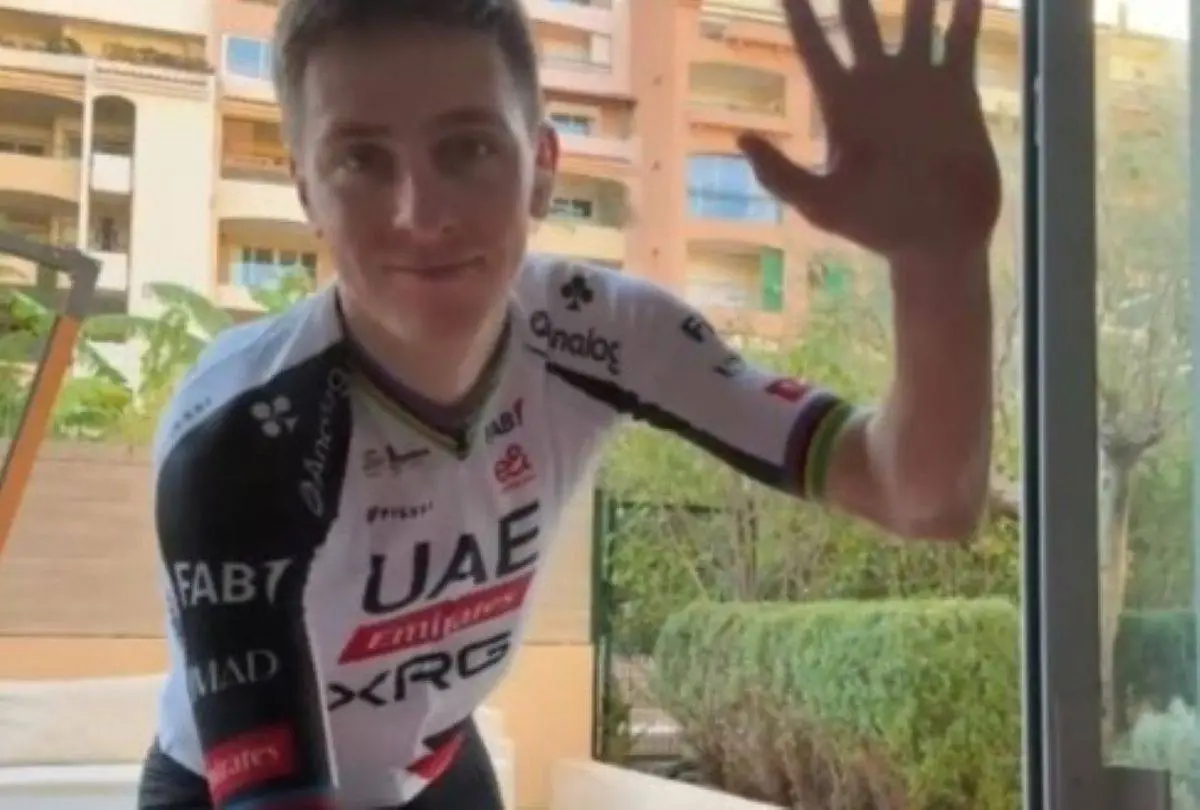
Tadej Pogacar after his serious crash in the Vuelta.
Pogacar's recovery did not go from strength to strength
Pogacar’s recovery—he also suffered a concussion—wasn’t a steady upward trajectory. “When I started using the stationary bike and going to physical therapy every day, I began to feel better—mentally, too," he said.
"But it was a daily struggle. Some days I wanted to do everything: physical therapy, the gym, rollers, a two-hour walk. You just have that energy. But the next day, I might just want to do nothing all day.”
"People who've been through it themselves, or know someone with a broken vertebra, know how serious it is. It was strange, because it didn't really hurt where it was broken; I was focusing more on my collarbone," he explains.
"You have the internet, and you can look it up. You see that it’s pretty serious and that you shouldn’t take it lightly. It’s pretty scary to think about."
"For the first four or five days I was in the hospital, my recovery score was yellow, but my heart rate variability and heart rate were really, really bad," Pogacar adds, citing the data.
“After that, over the next four or five days, my recovery score was completely in the red. I lay on the couch all day and did nothing. It took four weeks for my score to turn green again—only then was I able to train and move around again, and my heart rate returned to normal.”
Read also

Tadej Pogačar in the Vuelta a España.
Pogacar on safety in cycling
Pogacar’s crash this year was not an isolated incident. Just a few weeks earlier, Finlay Tarling died during the Tour of Portugal. “These accidents are becoming more and more common. I’ve seen statistics showing that they mainly affect riders under 23, and I don’t think that’s a coincidence, because the organization of these races is of an even lower standard than in the WorldTour.”
"There are fewer safety protocols, fewer police officers, and fewer people maintaining the roads. Even when you compare the Tour de France to another race on the WorldTour calendar, the difference is enormous. In the Tour [de France], there are police officers on almost every corner, signage is very good, and the road is kept clean. In other races, that’s just not there, is it?” he wonders in The Athletic, the sports division of The New York Times.
Pogacar sees yet another problem. “Speeds are much higher, but the finishes are the same. And there are more speed bumps than there were ten years ago—they’re meant to slow down traffic, not to be raced over. The organisers should clear the road better, improve signage, and make the finish less dangerous. The finish doesn’t have to be wide and straight on an eight-lane road like at the Tour of Guangxi, but we do need to avoid poor road surfaces and turns in the final 500 meters, potholes, speed bumps, and roundabouts.”
Read also
David Bavin-HobbsChief Editor
David has been working in the sports & cycling industry for 16 years. Covering racing, business and technology, he has worked in communications for cycling companies, teams, and as a journalist. His proudest achievement is winning the first bike race he ever entered. He hasn't won a race since.
IDL-productions
Pogačar, Vingegaard and Van Aert went faster again in 2026... except when they didn't
Team GB dominate, China on the rise, Lavreysen the best ever? Five takeaways from the 2026 Track World Championships
Track World Championships day 2: A golden day for Team GB, Levreysen goes 2 for 2, and Kopecky eliminates the competition
Rumours, speculation and guesswork: 2027 Tour de France route will be revealed live on October 22 in Paris
Vollering adds the Women’s European Championships road race jersey to her rainbow wardrobe
Latest Cycling News
Tom Pidcock’s brother puts an end to his ordeal: 'This year, I don't hate cycling, and I don't want to either'
Tadej Pogačar on Mathieu van der Poel and Tom Boonen, but also kiwi/pineapple, visualisation and the Gravel World Championships
Greg LeMond accuses Lance Armstrong of paying the UCI : 'Very bitter taste in my mouth'
Modern Adventure just keeps growing: Hincapie's team strengthen 2027 roster with 4 great signings
Pogačar, Vingegaard and Van Aert went faster again in 2026... except when they didn't
Popular Cycling News
Skjelmose angry with developments at Lidl-Trek: 'That doesn’t sit well'
French Paralympic Champion suspended following positive EPO test
Greg LeMond accuses Lance Armstrong of paying the UCI : 'Very bitter taste in my mouth'
Tadej Pogačar on Mathieu van der Poel and Tom Boonen, but also kiwi/pineapple, visualisation and the Gravel World Championships
Modern Adventure just keeps growing: Hincapie's team strengthen 2027 roster with 4 great signings
Latest Comments
- The team says it wants answers “as quickly as possible”, but speed shouldn’t come at the expense of a thorough investigation. Since Picnic PostNL commissioned it, will the full report be published? The team’s transparency will matter as much as who leads the inquiry.cyclechamp4530-10-2026
- How can current riders give evidence without their comments being traced back to them? That seems especially important in a case about fear.raceready730-10-2026
- Olfers’ experience with the Rasmussen case is relevant: that inquiry also scrutinised the team’s decisions, not just the rider’s. Let’s hope this one looks closely at management and working conditions too.patriciaw30-10-2026
- An independent investigation is the right step, but it needs to be genuinely independent in practice. With 71 people already speaking to NOS and Thijs Zonneveld, Verinorm has a substantial starting point. I hope people can give evidence confidentially and the findings are made public.breakawaybikerd30-10-2026
- - I’m still figuring out the race categories: would a2 event like Battenkill attract the same teams and TV coverage as a WorldTour race?jennifer1929-10-2026
- - Seeing McNulty, Simmons and Jorgenson race on home roads would be a real boost. Hope this becomes more than just talk.raceready729-10-2026
- - Putt is right that a major race could bring cycling to people who don’t follow the sport yet. But the old Tour of California ran into financial trouble—what would make a revival sustainable this time?pedalpowe2929-10-2026
- - A Tour of California comeback would be brilliant. Pogacar winning the last edition seems a long time ago now!davidm29-10-2026
- Did I read this right: he won stages at the Tour, but also had to do the whole race on his own? How does one rider manage all those wins in a season?raceready728-10-2026
- Five Tour de France stages and the overall win? Pogačar’s level is just ridiculous.cadencekingm28-10-2026
Loading