After hearing this from the peloton, you may watch the final 150 kilometres of Milan-Sanremo differently
CyclingSaturday, 21 March 2026 at 09:20
Follow IDL Pro Cycling on Google
Stay up to date with the best cycling news by making us a preferred source on Google.
Follow us on GoogleThe finale of Milan-Sanremo is often described as the finest half-hour of the cycling season, but that is not necessarily how the riders in the bunch see it. Long before the race reaches the foot of the final climbs, there is already another battle unfolding inside the race itself. On Friday in Pavia, IDLProCycling.com asked around to find out what it is really like to race through the pretty villages along the Ligurian coast with a full-speed peloton on edge.
ADVERTISEMENT
Dutch national champion Danny van Poppel, who lives in Monaco about an hour’s ride from Sanremo, will line up for his ninth Milan-Sanremo on Saturday. “On paper it should be a good race for me, but I was never really good here. It has changed so much over the last two years,” concluded the sprinter, who still has plenty of engine for the harder races.
“In the bunch, people are saying they ride the Cipressa more than a minute faster than a few years ago. It is becoming more and more of a climbers’ race. We have Primoz Roglic and Giulio Pellizzari with us, and in the end that is mainly because of Pogi, who wants to win here.” That gets the elephant in the room out of the way immediately.
Continue reading below the photo!
‘When they get to the bottom, they always stop to pee anyway’
For the past three years, the race has no longer started in Milan itself, but in the slightly more southerly town of Pavia. From there, the riders are sent out across the Po Valley. They travel south-west over the Passo del Turchino before, after 153 kilometres, reaching Voltri and beginning to follow the coastline westwards.
“It is already really nervous by then,” confirmed Tudor outsider Rick Pluimers. “You have to get over the Turchino, and then it already becomes hectic in the descent, because nobody wants to be too far back there. If it stretches into a line, you risk having to make a big effort to get back. On the other hand, every time you get down to the bottom, they stop to pee again anyway… it is always the same,” he laughed.
“Then you get down there and there are still 140 kilometres to go, but that is when the stress really starts,” the Dutchman continued. “You go through all those villages along the coast, where it is chaos with all the roundabouts, traffic islands and all the rest. You are focused, but it already hurts quite a bit there. After the finish you forget that, but it is already super fast at that point.”
“Those kilometres are really hectic, because all those villages and little roads on that coastal route look the same as well. That is exactly why it becomes so chaotic, because everybody thinks: we are already there,” added Van Poppel, who trains in this region more often than most.
Continue reading below the photo.

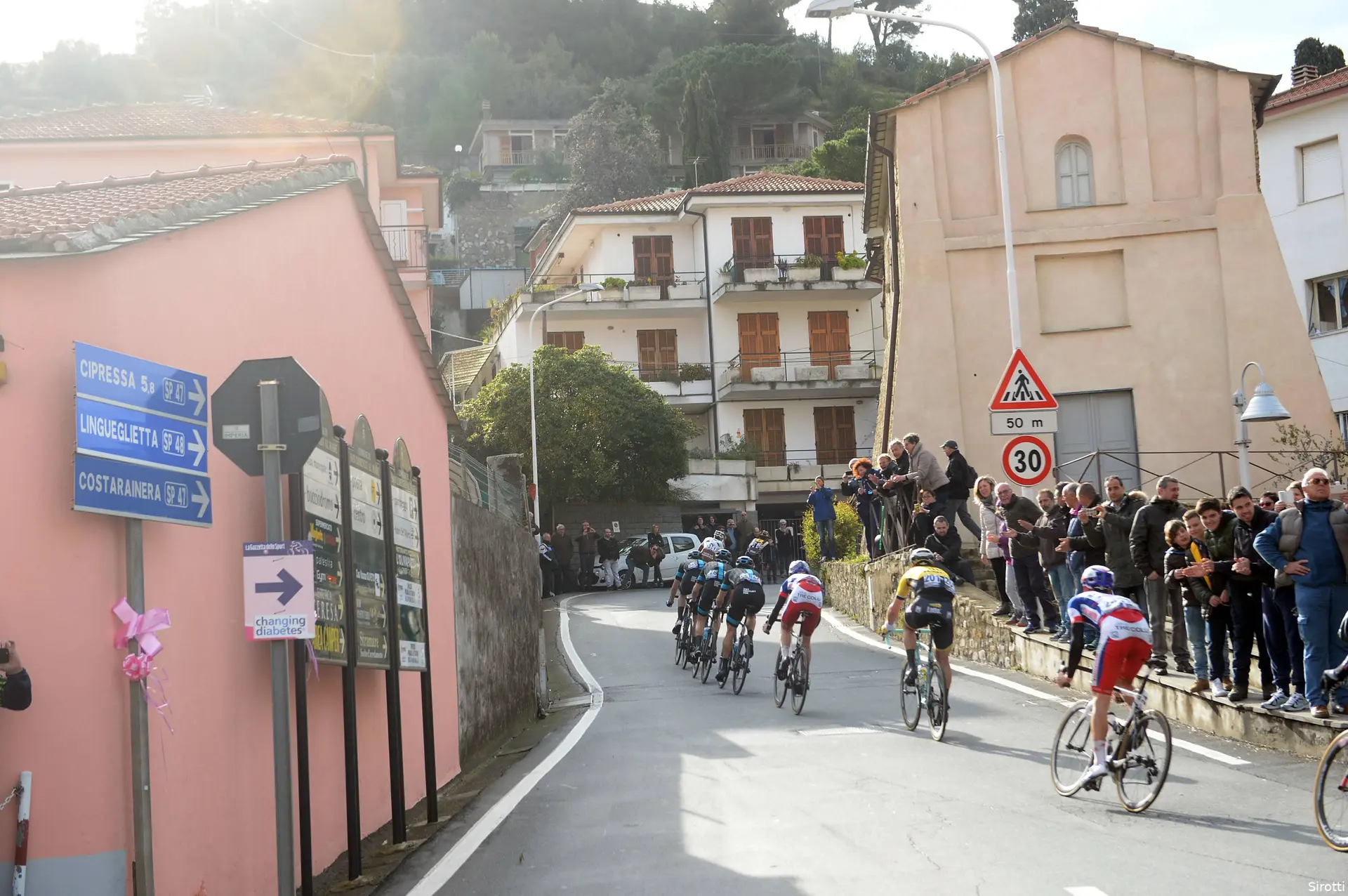
After about 150 kilometers, the riders will reach the coast.
‘Helpers used to hope to survive the Cipressa — not anymore’
Once the riders reach the Capi, the pace always rises again. “They always go hard on those climbs as well, so you need to be in position there too. Heading towards the Cipressa, it almost becomes like a lead-out for a bunch sprint on top of that, and that is when it really starts,” said Pluimers. Van Poppel believes that can sometimes be exaggerated a little. “It is very nervous, but if you ask me? If you are in the top 40 before the Cipressa, that is also fine as an outsider.”
Tomas Kopecky has been acting as road captain for Unibet Tietema Rockets for some time now, and he will take on that role again in the team’s first Milan-Sanremo. “To people on the outside, it may not always look like it, but in so many races you have those different crucial moments. It is always hectic, but especially in the Classics.”
“The more often you find yourself in that situation, the more you develop a kind of calm in the chaos. Controlled panic, while still thinking clearly and sticking to the plan,” he explained. “It is very tempting to keep pushing all the time, but in the end something always opens up somewhere. But heading into the Cipressa, you should not even think too much in terms of efforts — you just need to be incredibly good. That is where my finish line is, and then I will see how much farther I can get after that.”
“That is the difference now: in the past, riders were told on the team bus that the helpers could survive the Cipressa and still do something towards the Poggio, but that is no longer realistic,” Van Poppel explained. To use the words of Florian Vermeersch, runner-up in Omloop Het Nieuwsblad: “My job is mainly to cover the Capi and deliver the guys to the Cipressa in the best possible position. That is a very important role, and I am happy to take that on for this team.”
Continue reading below the photo!

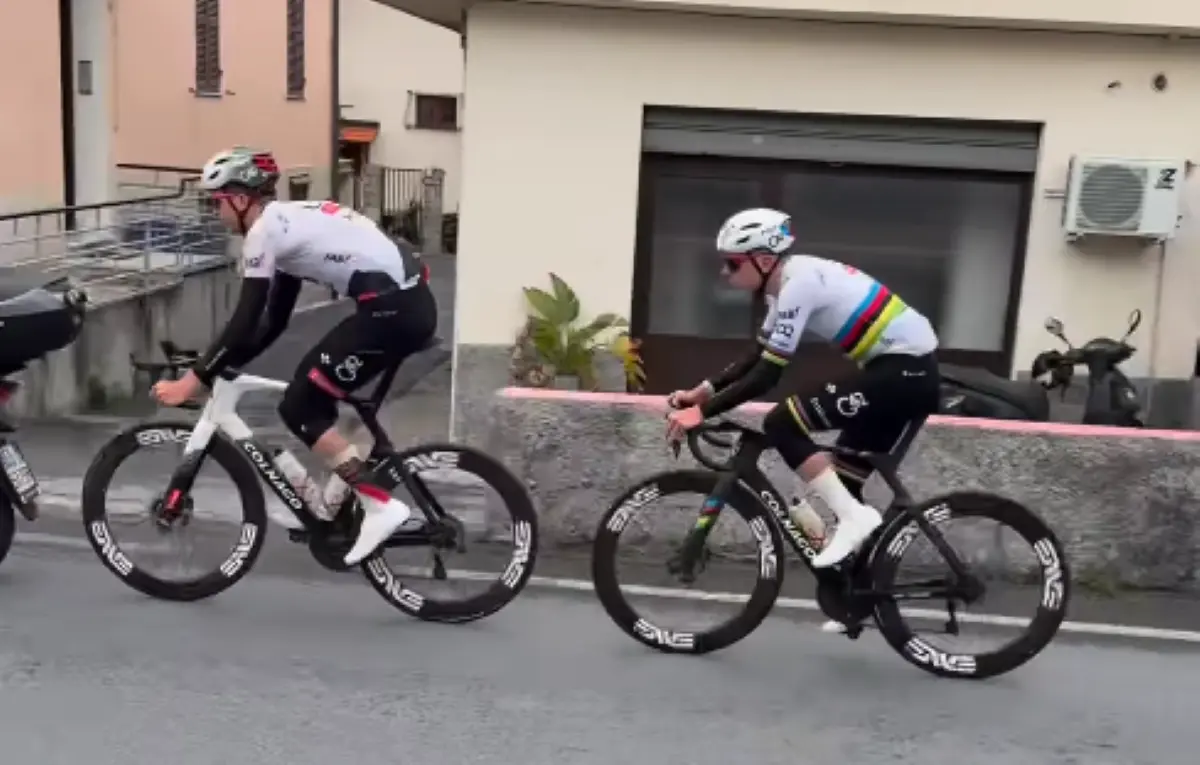
Cipressa: the benchmark in Milan-Sanremo.
‘It often goes well in Milan-Sanremo’
Once that battle for position is done, the handbrake can finally come off. Pluimers knows what that feels like: in 2025 he entered the Cipressa in perfect shape. “I was there in a good position, around fifth wheel. And I still remember how much it hurt. By the time I exploded, Pogacar and Van der Poel were only just launching. That was pretty impressive to see.”
“On the other hand, it was still only two or three riders, and everything behind them stayed pretty close together. It was up to the rest to try and hang on,” said Pluimers. Mike Teunissen, who finished eleventh last year, added: “They are the riders with the most talent, and on top of that they do not make mistakes. They know what they have to do, how to take care of themselves, how to prepare, and they do everything right.”
Reading all that, you might wonder why Milan-Sanremo is not especially known for the kind of major crashes we have seen in the Tour of Flanders, Paris-Roubaix and even Omloop Het Nieuwsblad in recent years. “It often does go well, but there are still crashes every year,” said Pluimers. “I know that, because I crashed myself two years ago just before the Cipressa.”
And if you have made it this far, Teunissen had one final Milan-Sanremo summary to offer. “A little bit of stress before the Turchino, but not too much. Then you take off the jacket and prepare yourself for the drag race and those climbs, trying to get a good result. It is the same every year.”
Read also
Tom van der Salm (27) comes from the charming town of Zeilberg (Deurne) in the Netherlands and has been working as editor-in-chief & journalist at IDL Pro Cycling's parent site, In de Leiderstrui, since 2019. He travels with the peloton from the Tour de France to the AlUla Tour and from the World Championships in Rwanda or Canada to the Zilvermeercross in Mol. In his spare time he enjoys playing football, mountain biking, running, walking with his Labrador/Stabyhoun, investing, holidays, (specialty) beers, reading, cooking and watching sports & documentaries!
Contact: [email protected]
IDL-productions
Tadej Pogačar's 2027 schedule is shaping up and it is mega: Tour de France #6, 'Super Worlds', and unfinished business in Spain
An American rider can win the Elite Men’s World Championship road race, but the smart money isn’t on Quinn Simmons!
Demi Vollering take note: Elite debutant Zoe Bäckstedt's previous World Championship results show why she's a contender

Female stars from across cycling disciplines, including Demi Vollering, condemn Sydney Sweeney 'sports' video

2026 GP Montreal preview | Evenepoel and Pidcock face World Championships dress rehearsal
Latest Cycling News
Filippo Ganna ditches his extreme time trial position to try to beat Evenepoel at the World Championships
From a Tour of Britain water bottle to Visma's junior team: 17-year-old Scot Xander Graham is following his pro cycling dream
Tadej Pogačar's 2027 schedule is shaping up and it is mega: Tour de France #6, 'Super Worlds', and unfinished business in Spain
After Pogacar and Zigart, Slovenia forced to drop another big name for the World Cycling Championships
UCI issues scathing ruling following 'professional misconduct' and imposes a 10-year suspension
Popular Cycling News
UCI issues scathing ruling following 'professional misconduct' and imposes a 10-year suspension
Ben Turner's departure from Netcompany INEOS isn't all that surprising once you hear his story: 'The team I looked up to'
Sepp Kuss is a special kind of cyclists, one we’re seeing less and less: 'It's a good formula for me'
Covered in mud and fully geared up: Pidcock is well prepared for a unique World Championship opportunity
Tadej Pogačar's 2027 schedule is shaping up and it is mega: Tour de France #6, 'Super Worlds', and unfinished business in Spain
Latest Comments
- - Vamos Aotearoa! Finn en forma después de la Vuelta y Pologne. Allez les Kiwis, bring it home.andrewf18-09-2026
- - Bit sceptical tbh. Saying “prioritise the track” feels like a convenient excuse when your best recent Worlds result is on the road. If you want results, back the athletes. This policy almost incentivises selfish racing.samanthak18-09-2026
- - Stoked to see Niamh back after silver in Kigali. Hard to believe that podium didn’t unlock any change. If the men ride with numbers into the final, Corbin Strong’s kick plus Finn on the climbs could be a nice one-two.jennifer1918-09-2026
- - Wait, why doesn’t the federation cover flights if they’re sending a team? If CNZ has $70k for “delivery,” what does that actually mean in practice—staff, cars, hotels?jeremya18-09-2026
- - Really solid piece. Finn’s honesty about the “everyone pays their own way” dynamic is eye-opening and explains why NZ often rides more opportunistically at Worlds. Montreal’s punchy laps suit him and Pithie—top 10 isn’t crazy.sprocketspiny18-09-2026
- - Love the Simmons/Jorgenson/Powless trio for USA. That’s a lot of horsepower to keep Brandon fresh. If they time the bridge before the final ascent, it’s game on. Vamos USA!velodromevirtuoso118-09-2026
- - Del Toro winning while Yates policed moves was classic UAE chess. Without that structure at Worlds, can McNulty read the chaos as a sole leader? He’s earned the shot, but the race will be messy.cadencekingm18-09-2026
- - Question: why does the climb being6 km matter so much? Is it more about punch vs pure climbers? Trying to understand why McNulty suits this course over, say, Remco.jeremya18-09-2026
- - Not sure I buy the “favourite” tag. Montréal one-day is not Worlds with national teams and weird alliances. Evenepoel and Pidcock will race totally different next time. Cautious optimism, not hype.sprocketspiny18-09-2026
- - Huge ride from McNulty. Third on the Worlds circuit against that field is no fluke. If Simmons and Jorgenson mark the early fireworks, Brandon can launch on Camillien-Houde last lap. USA actually looks stacked for once.julien18-09-2026
Loading