'Nothing could be further from the truth': Mathieu Heijboer pushes back on cycling's data myth
CyclingMonday, 11 May 2026 at 16:36
Follow IDL Pro Cycling on Google
Stay up to date with the best cycling news by making us a preferred source on Google.
Follow us on GoogleData has become an increasingly important part of professional cycling — and for many traditional fans, that is a source of frustration. But just how large a role does it actually play? Mathieu Heijboer, Head of Performance at Visma | Lease a Bike, gave a fascinating insight into how his team uses data — and how much they don't — on the In De Waaier podcast. Cycling romantics, this one's for you.
ADVERTISEMENT
First, the word "data" itself — because even Heijboer is aware of the baggage it now carries. "Data is seen as: it's numbers. For me, feedback from a training session can also be considered data — a different kind, granted. Data has developed a slightly dirty reputation, but the question is: what do you actually do with it?"
'Intuition and creativity determine whether you win a race or not'
From the outside, there is a widespread assumption that Visma | Lease a Bike are intensely data-driven. Heijboer pushes back on that. "People think it's very data-driven, but we are above all very people-driven." Where does the perception come from, then? "You don't see those conversations, but after a stage you do see all the climbing times and power outputs. That's what people see."
"I think followers have always loved the romance of cycling. In that sense, they lose that affection when it's supposedly all pre-programmed. I still believe, ultimately, that intuition and creativity determine whether you win a race or not," says the former professional cyclist, striking an important note.
Continue reading below the photo!

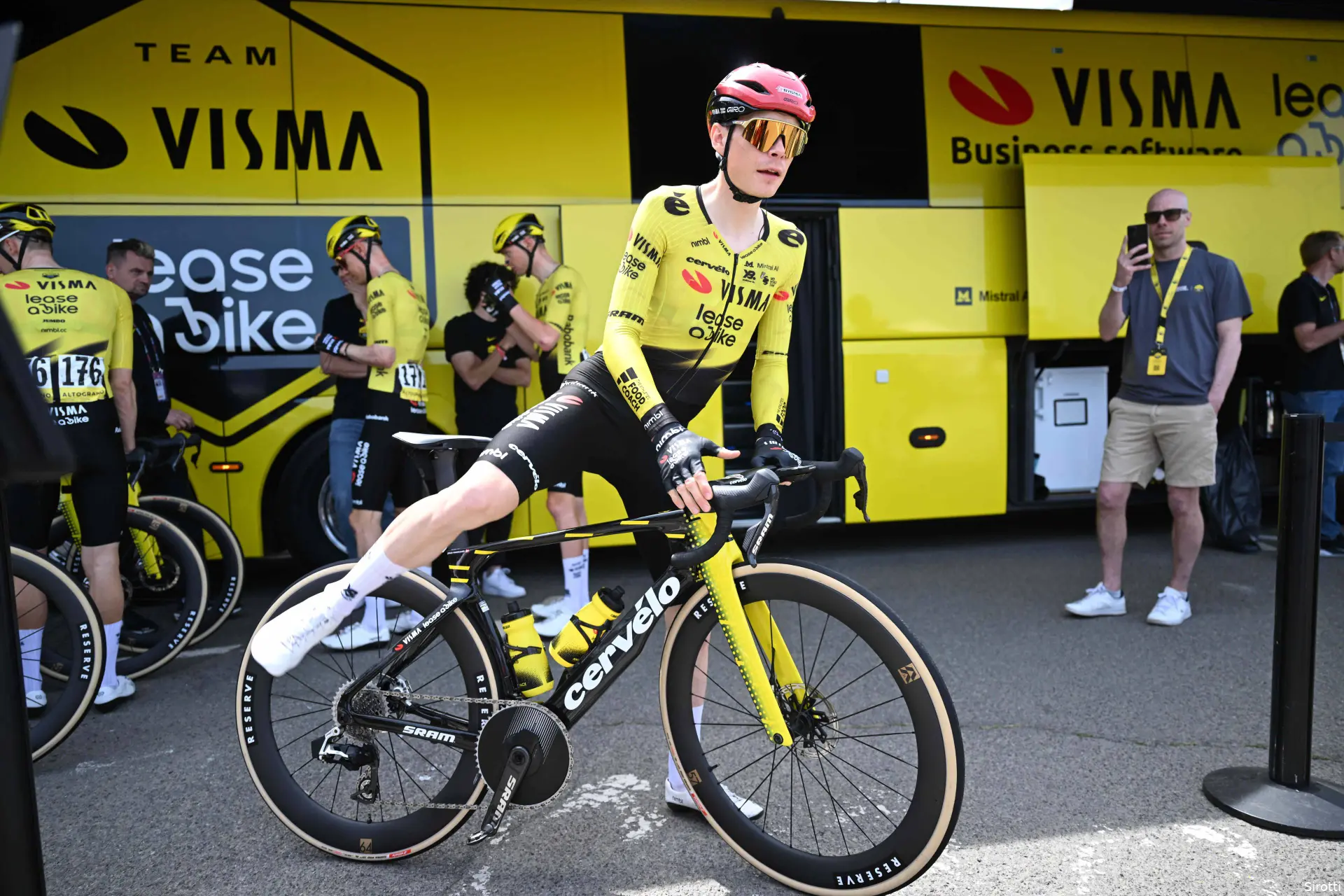
Mathieu Heijboer, Visma | Lease a Bike's performance chief
'We also coach riders on this: go on feel'
That said, data is still a vitally important part of the picture. "There is a great deal of information available that can be particularly useful behind the scenes, to ensure that intuition can do its work at the right moment." Because according to Heijboer, intuition is genuinely the decisive factor.
The Dutchman explains. "I know that not many riders actually look at their numbers on a climb. They manage that effort much more on feel." For other types of stages, it is different. "In a time trial, you can calculate fairly precisely in advance what average speed you need to maintain over a given distance, and what finishing time that will produce" — referring to what is widely known in cycling as pacing.
But: "How we shape that pacing is by feel," Heijboer repeats. "In time trials, for example, we divide the route into a number of sectors. We give riders guidance: here you go almost flat out, here you recover... you're not working with robots, of course. You can certainly use historical data to estimate that a rider can sustain 450 watts over 20 minutes. But I hope that on the day it turns out to be 460 watts. That I cannot predict."
The danger, in fact, is paying too much attention to the data. "If I pin the rider to that number, I'm certain it will either end in disappointment, or that he won't get the maximum out of himself. We also coach riders on this: go on feel. That's how they train at home too" — meaning Visma | Lease a Bike's riders are actively encouraged to race on instinct rather than numbers.
Continue reading below the photo!

Heijboer counters the data myth: 'Nothing could be further from the truth'
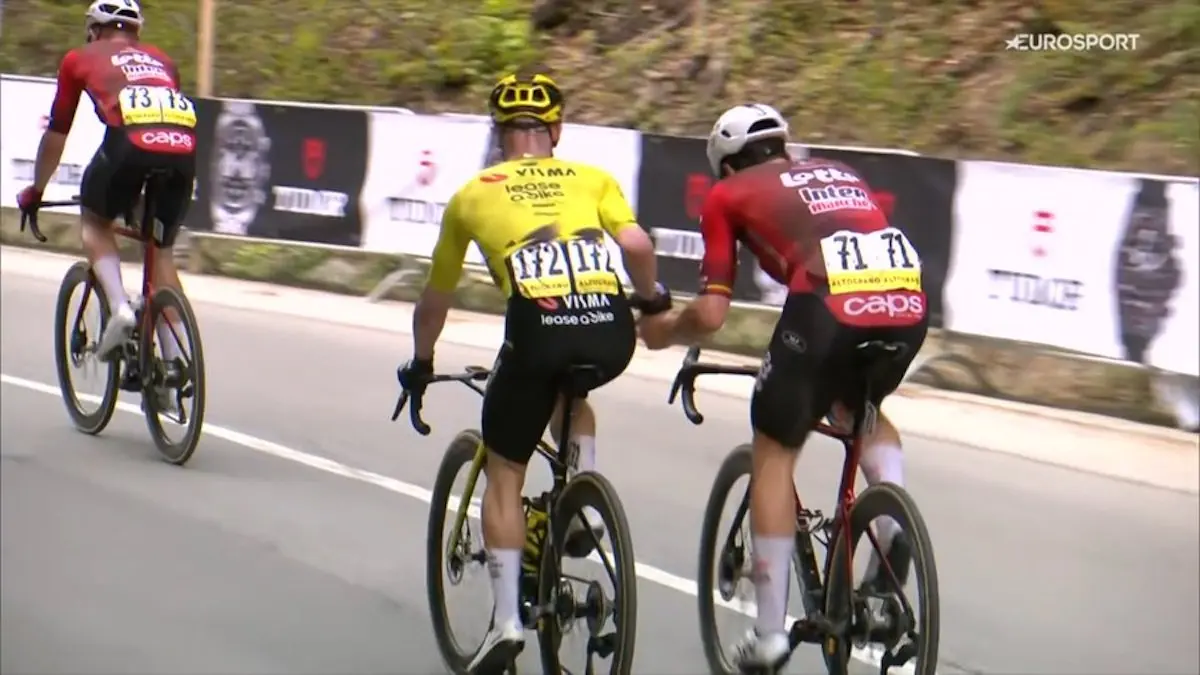
The best example? "The famous time trial in 2023" — referring to the stage 16 time trial at that year's Tour de France, with which Jonas Vingegaard ultimately won the race. "He looked at his power meter once and thought: that can't be right, I'm going way too hard. But I feel good, so I'm just going to keep going. That also comes from the coaching: ride this time trial on feel, but stay sharp."
"So it is much more about coaching on feel than on data," Heijboer continues. "We do use data in the background — to learn from it and to do things better in the future." Yet he is also acutely aware: "Around our team, and in cycling more broadly, there is a perception that things have gone so far that it is only about data and that feel no longer plays any role. Nothing could be further from the truth."
"But I also don't want to say that data plays no important role in how we analyse things, because there is a lot of valuable information hidden in there. We try to keep a certain amount of that away from the riders — because they don't always benefit from knowing it all. A rider, a person, gets better when you treat them like a human being. But all these riders are top-level athletes, hugely motivated, so they want to know everything too," Heijboer concludes.
IDL-productions
Three world titles, two heart surgeries, and one last U23 chance: the Rogers family story behind Cameron's World Championship heartbreak
Mathieu van der Poel sees '1,000 scenarios' for the World Cycling Championships road race: 'Actually reminds me a bit of Glasgow'
Here's why the 2032 World Championships were awarded to India, not the Netherlands
Who is Isabella Holmgren, the 21-year-old Canadian who is the clear favourite for the women's U23 world championship?
Australia leave team spots empty, USA riders pay $1,000 to race: the World Championships' national team model faces serious financial problems
Latest Cycling News
2026 Women's World Cycling Championships Preview | Saturday's big race sees Demi Vollering take on the world
Wout van Aert speaks about working with Evenepoel at the World Championships: 'We have to be able to make choices'
Van der Poel likes Del Toro's chances at the World Championship road race: 'Strong enough to do his own thing even without a team'
Evenepoel makes bold prediction about one rider at the World Championships: 'He can definitely dominate everyone and everything here'
Sivakov is impressed by 20-year-old Seixas at the World Championships: 'Paul reminds me of Tadej'
Popular Cycling News
Disappointed Belgian Driesen has his doubts about the legitimacy of Barry's victory: 'They'll say I'm a sore loser'
2026 World Cycling Championships Route & Schedule | America wins its first medal, here is the weekend schedule
Tom Pidcock has four specifically picked domestiques in his hunt for a record-breaking rainbow jersey
Who is Isabella Holmgren, the 21-year-old Canadian who is the clear favourite for the women's U23 world championship?
🎥 UCI cracks down hard after insane footage of flying car at Junior World Championships
Latest Comments
- - Wout + Remco “riding in sync” gives me Leuven vibes. If they play it smart—Remco long-range, Wout sprint from a reduced group—Belgium could realmente dominar. Go on lad!michael5426-09-2026
- - Not sure I buy the jet lag bit. Late travel to North America has bitten riders before. Why risk that when others have been in Canada for a week?jennifer1926-09-2026
- - Love that he addressed Pogačar’s absence without gloating. Still, let’s be honest—no Pog means the Belgians have to control different threats, especially MvdP and maybe Hirschi. Gonna be a chess match late doors.sprocketspiny26-09-2026
- - Quick question: when they say the course is “a lot longer now,” how many kilometres are we talking compared to the GP Montréal? And does extra distance really suit Wout over Remco?cadencekingm26-09-2026
- - Proper interview! Wout sounds calm and dialled after that Vuelta block. If he’s carrying that points jersey form into Montréal, he’ll be in the mix on Camillien-Houde every lap.velodromevirtuoso126-09-2026
- - Vamos Isaac! But the article’s right—Mexico won’t be able to support Del Toro if Remco and MVDP turn the screws. Sin equipo fuerte es muy difícil. Still, I’d love a shock podium from him.michael5426-09-2026
- - Quick one: does “same course” literally mean identical to GP Montréal, or just similar laps/elevation? Trying to understand why that rehearsal is such a big indicator.samanthak26-09-2026
- - Is Seixas really 19? That’s a huge load for a Worlds road race. One bad moment and France has no plan B. Seems risky when you’ve got Sivakov and Paret-Peintre there.robert6526-09-2026
- - Remco + WVA with “two strategies” sounds terrifying. If Belgium launches Wout early and keeps Remco in the wheels, who’s marking both? The Brits and Dutch won’t have numbers if it kicks off on the penultimate climb.velodromevirtuoso126-09-2026
- - Love the unity from Les Bleus. Voeckler turning a camp into a proper team-building bootcamp (laundry and cooking!) is genius. If they control the Montreal laps like they did at GP Montréal, Seixas has a real shot. Allez!cadencekingm26-09-2026
Loading