Cycling world might never have known African revelation: Kimberley Le Court “had a 10% chance of surviving”
CyclingWednesday, 04 March 2026 at 12:16
Follow IDL Pro Cycling on Google
Stay up to date with the best cycling news by making us a preferred source on Google.
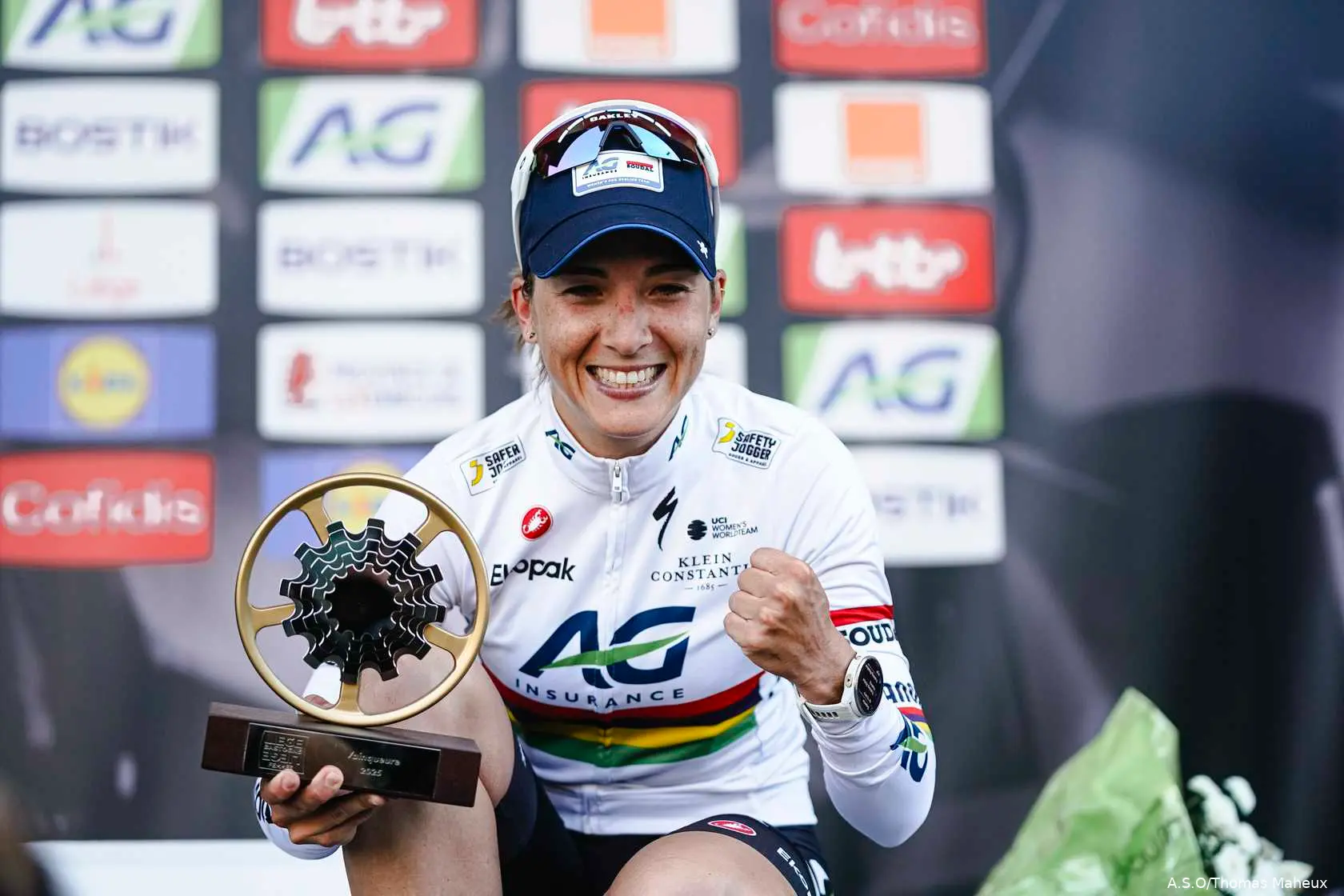
Follow us on GoogleThe impact Kimberley Le Court has had on women’s cycling has been huge over the past year. The rider from Mauritius produced one of the shocks of the season by winning Liège-Bastogne-Liège, putting African women’s cycling firmly on the map. Later in the year she also won a stage — and wore the yellow jersey — in the Tour de France Femmes, something that, by her own account, could easily have never happened. In an interview with Radio Peloton, Le Court shared the intense story from her early childhood.
ADVERTISEMENT
Le Court was born on 23 March 1996 in Curepipe, on Mauritius. In her first years, her family moved to Madagascar. “For one or two years,” she remembers. Things went wrong quickly on the island. “That’s when I contracted malaria,” Le Court begins, describing a period that left a deep mark.
It became a chapter with lasting impact for her family. “It’s something they don’t really talk about,” she explains. “When I was little, we had a camera and everything was filmed. My parents would film me walking down the street and things like that… and they also filmed the moment I got sick.”
In hospital, there was no filming. “But my dad did film my brother waiting outside the hospital, for example. It’s still a story where I don’t know every single detail. If my parents try to talk about it… they just can’t. It makes them too emotional.”
Continue reading below the photo!

“I only had a 10% chance of surviving”
Le Court’s odds, she says, were anything but good. “I only had a ten percent chance of surviving,” she says, visibly fighting emotion. From Madagascar, the family then travelled to France. “That’s where I was taken to a doctor, but in France they didn’t know malaria,” she recalls. “They said it was just the flu, so I was sent home.”
Back at home, she only became sicker. A second doctor’s visit brought the same conclusion, and things continued to worsen. “By the third time, I couldn’t walk anymore. An ambulance came to pick me up because I’d gone into a coma. Only then did they realise I had been in Madagascar — because I’d lived there for one or two years, and then I’d gone to France.”
That finally changed the doctors’ thinking. “Then it clicked and they thought: maybe we should call the doctors in Madagascar to find out more. They only discovered very late that I had malaria, because by then I had only a ten percent chance of surviving.”
Continue reading below the photo!

Le Court woke up on a bike in the hospital corridor
A high-risk medication was brought in from Madagascar, and Le Court says her father had to sign a statement acknowledging responsibility for any consequences. “It works for some people, and for others it doesn’t,” she explains. “So we didn’t know if it would take.” At the time, her brother was even called and told he should come to say goodbye.
Fortunately, the treatment worked. “The next morning I woke up on a bike, in the hospital corridor,” Le Court says. “What I remember is that I had an IV in my arm, but I had to keep my arm straight while I was on the bike. The day before, I was almost dead.” A dramatic story — and one that, years later, makes her rise to the top of the sport feel even more remarkable.
All’s well that ends well for Le Court, although she stresses how heavily it affected her family. “It was a really difficult period for my parents and my brother. They remember everything — I was still very young.” Thankfully, it now feels far away. “These days I never get bitten by a mosquito,” the Mauritian rider laughs.
IDL-productions
Three world titles, two heart surgeries, and one last U23 chance: the Rogers family story behind Cameron's World Championship heartbreak
Mathieu van der Poel sees '1,000 scenarios' for the World Cycling Championships road race: 'Actually reminds me a bit of Glasgow'

Here's why the 2032 World Championships were awarded to India, not the Netherlands
Who is Isabella Holmgren, the 21-year-old Canadian who is the clear favourite for the women's U23 world championship?
Australia leave team spots empty, USA riders pay $1,000 to race: the World Championships' national team model faces serious financial problems
Latest Cycling News
2026 Women's World Cycling Championships Preview | Saturday's big race sees Demi Vollering take on the world
Wout van Aert speaks about working with Evenepoel at the World Championships: 'We have to be able to make choices'
Van der Poel likes Del Toro's chances at the World Championship road race: 'Strong enough to do his own thing even without a team'
Evenepoel makes bold prediction about one rider at the World Championships: 'He can definitely dominate everyone and everything here'
Sivakov is impressed by 20-year-old Seixas at the World Championships: 'Paul reminds me of Tadej'
Popular Cycling News
Disappointed Belgian Driesen has his doubts about the legitimacy of Barry's victory: 'They'll say I'm a sore loser'
2026 World Cycling Championships Route & Schedule | America wins its first medal, here is the weekend schedule
Tom Pidcock has four specifically picked domestiques in his hunt for a record-breaking rainbow jersey
Who is Isabella Holmgren, the 21-year-old Canadian who is the clear favourite for the women's U23 world championship?

🎥 UCI cracks down hard after insane footage of flying car at Junior World Championships
Latest Comments
- - Wout + Remco “riding in sync” gives me Leuven vibes. If they play it smart—Remco long-range, Wout sprint from a reduced group—Belgium could realmente dominar. Go on lad!michael5426-09-2026
- - Not sure I buy the jet lag bit. Late travel to North America has bitten riders before. Why risk that when others have been in Canada for a week?jennifer1926-09-2026
- - Love that he addressed Pogačar’s absence without gloating. Still, let’s be honest—no Pog means the Belgians have to control different threats, especially MvdP and maybe Hirschi. Gonna be a chess match late doors.sprocketspiny26-09-2026
- - Quick question: when they say the course is “a lot longer now,” how many kilometres are we talking compared to the GP Montréal? And does extra distance really suit Wout over Remco?cadencekingm26-09-2026
- - Proper interview! Wout sounds calm and dialled after that Vuelta block. If he’s carrying that points jersey form into Montréal, he’ll be in the mix on Camillien-Houde every lap.velodromevirtuoso126-09-2026
- - Vamos Isaac! But the article’s right—Mexico won’t be able to support Del Toro if Remco and MVDP turn the screws. Sin equipo fuerte es muy difícil. Still, I’d love a shock podium from him.michael5426-09-2026
- - Quick one: does “same course” literally mean identical to GP Montréal, or just similar laps/elevation? Trying to understand why that rehearsal is such a big indicator.samanthak26-09-2026
- - Is Seixas really 19? That’s a huge load for a Worlds road race. One bad moment and France has no plan B. Seems risky when you’ve got Sivakov and Paret-Peintre there.robert6526-09-2026
- - Remco + WVA with “two strategies” sounds terrifying. If Belgium launches Wout early and keeps Remco in the wheels, who’s marking both? The Brits and Dutch won’t have numbers if it kicks off on the penultimate climb.velodromevirtuoso126-09-2026
- - Love the unity from Les Bleus. Voeckler turning a camp into a proper team-building bootcamp (laundry and cooking!) is genius. If they control the Montreal laps like they did at GP Montréal, Seixas has a real shot. Allez!cadencekingm26-09-2026
Loading