What do Pogacar's Tour de Suisse climbing stats tell us ahead of the Tour de France?
CyclingWednesday, 24 June 2026 at 12:44
Follow IDL Pro Cycling on Google
Stay up to date with the best cycling news by making us a preferred source on Google.
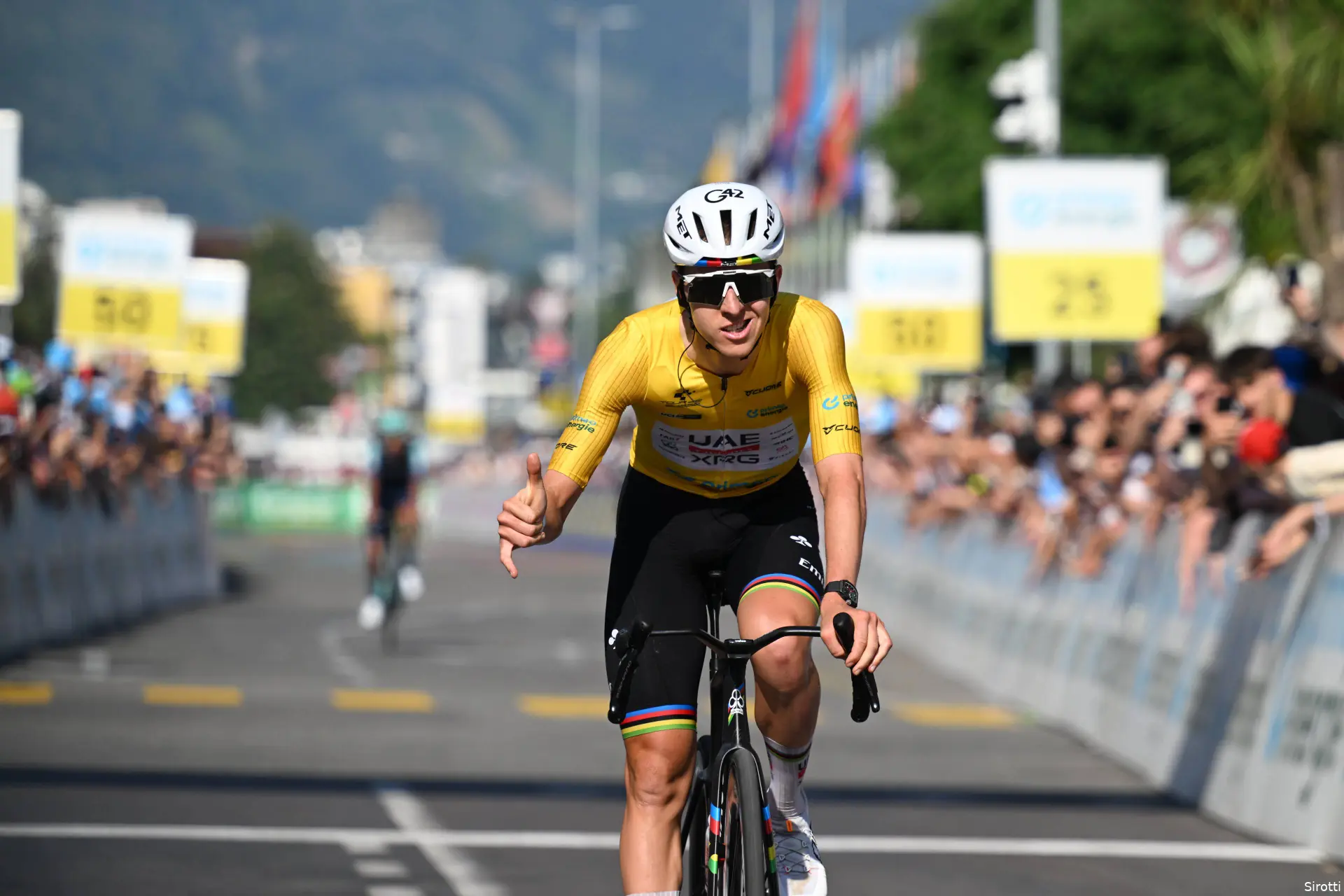
Follow us on GoogleTadej Pogacar won the Tour de Suisse by a margin rarely seen before. The Slovenian rider from UAE Team Emirates-XRG left his competitors in the dust, once again showcasing his climbing prowess in the grueling final stage. But what exactly did his performance on the way to Villars-sur-Ollon mean for the upcoming Tour de France?
ADVERTISEMENT
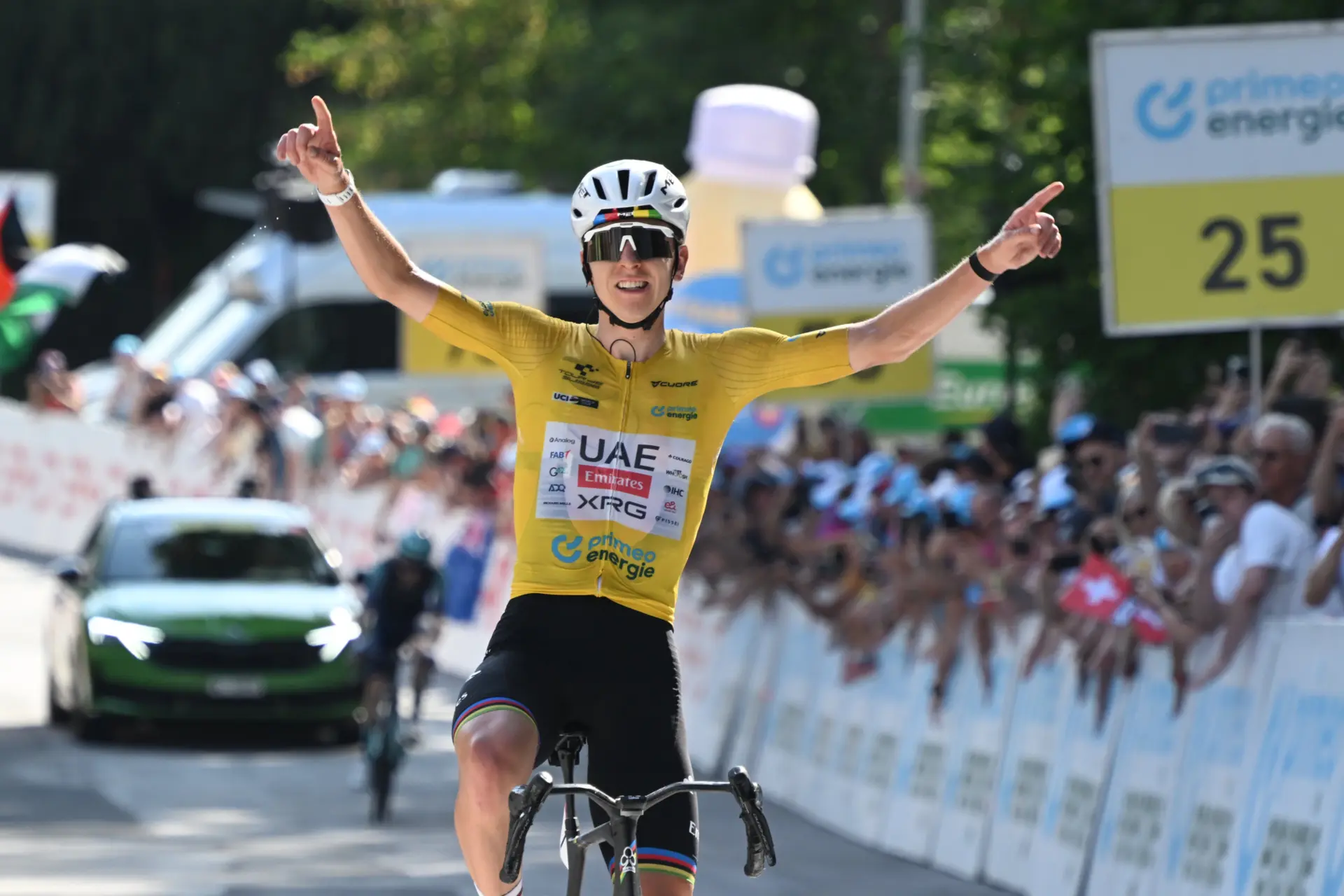
Pogacar let Decathlon CMA CGM do all the hard work in the queen stage, after which he accelerated about nine kilometers from the finish and pulled away with ease. On that climb, he closed the gap by nearly two minutes on the challenging Lenny Martinez (Bahrain Victorious), and thus the world champion won his third stage and the overall classification in Switzerland.
Pogačar dropped huge watts at Tour de Suisse
Everyone could see that he was climbing the mountain hard. But without riders like Jonas Vingegaard, Paul Seixas, and Florian Lipowitz in the mix, there were few metrics that truly showed just how impressive the climb was. That’s why cycling fan ammattipyöräily dug into the numbers. He calculated Pogacar’s wattage over the final 8.61 kilometers, starting from his attack.
He completed that section of the climb (average gradient of 8.04 percent, 692 meters of elevation gain) in 22 minutes and 8 seconds. That works out to an average speed of 23.34 kilometers per hour and a VAM value of 1,876 meters per hour. For those who need to know: the VAM value is the number of meters of elevation you gain in an hour. For a climb lasting over twenty minutes, these are fantastic numbers.
Read more below the dates!
Pogacar's Swiss W/kg an alert for Tour de France rivals
With an estimated weight of 65 kg, Pogacar’s performance translates to a watts-per-kilo value of 6.95. During the first three kilometers of the climb, that figure was as high as 7.28 watts per kilogram, after which it dropped to 6.88 watts per kilogram for the next three kilometers, and 6.64 watts per kilogram for the final 2.5 kilometers. That’s still not at the level he demonstrated two years ago on the Plateau de Beille.
However, the Tour de Suisse is not yet the Tour de France. The fact that Pogacar is showing these numbers in June—just under a month before the real test—is impressive. The Slovenian is expected to gain those final few percentage points in the coming days. It remains to be seen what level of form he’ll display in the Tour, but the early signs are certainly enough to strike fear into his competitors.
Read also
David Bavin-HobbsChief Editor
David has been working in the sports & cycling industry for 16 years. Covering racing, business and technology, he has worked in communications for cycling companies, teams, and as a journalist. His proudest achievement is winning the first bike race he ever entered. He hasn't won a race since.
IDL-productions
Here's why the 2032 World Championships were awarded to India, not the Netherlands
Who is Isabella Holmgren, the 21-year-old Canadian who is the clear favourite for the women's U23 world championship?
Australia leave team spots empty, USA riders pay $1,000 to race: the World Championships' national team model faces serious financial problems
George Hincapie and Benjamin Noval shared a bus as U.S Postal riders, now their sons are battling at the World Championships
This is how much prize money Remco Evenepoel and Demi Vollering could earn if they become world champions in Montreal
Latest Cycling News
2026 Elite Men's World Cycling Championships Preview | Evenepoel vs Del Toro vs Seixas vs Pidcock and the rest in Montréal
Tom Pidcock has four specifically picked domestiques in his hunt for a record-breaking rainbow jersey
17-year-old Benjamin Noval proves himself a climbing phenom at the Junior World Championships
Canada's Isabella Holmgren takes U23 silver in Montréal: 'If I had the legs, then I would have been alone'
Visma's Chladonova won the U23 world championships despite still being at school: 'I couldn’t train properly'
Popular Cycling News
Netcompany-INEOS think they have found the new Seixas — and the numbers back it up
2026 World Cycling Championships Route & Schedule | Time trials are done; here are the road race details
Tadej Pogačar is suddenly on the European Championships start list; UAE Team Emirates gives an explanation
After signing the 'new Seixas', INEOS have reportedly secured one of the Giro's quiet revelations for 2027
Who is Isabella Holmgren, the 21-year-old Canadian who is the clear favourite for the women's U23 world championship?
Latest Comments
- - Bravo Viki! Perfect patience, perfect sprint. Grande corso, fantastique finish. 🇸🇰👏patriciaw24-09-2026
- - Slightly harsh take: if Canada agreed the night before to launch on the penultimate lap, why go so deep a lap earlier? Felt like they burned the matchbook chasing Viki too soon. Maybe trust the plan?breakawaybikerd24-09-2026
- - Question: when they say there were no race radios, how do teammates coordinate on the course? Are there time gaps shown or boards from commissaires, or is it all just shouting and hand signals?sprocketspiny24-09-2026
- - Great ride by Fleur Moors too. Committing at 31 km to go forced the selection and probably saved her a messy bunch sprint. Bronze well earned.jeremya24-09-2026
- - What a duel. Chladoňová was ice-cold in the wheels and nailed the timing on the rise. Holmgren emptied the tank on both climbs; you could see she wanted to avoid a drag to the line. Hard to fault the tactics given no radios—just needed a tiny bit more snap.michael5424-09-2026
- - Mooi man! Groningen en Drenthe verdienen dit. Wind, waaiers, smalle wegen… echte koers. Succes voor 2034!tourdeforce924-09-2026
- - Not convinced by the “5 million spectators” number in Pune. Feels a bit inflated tbh. Infrastructure spend is great, but can they guarantee closed roads, heat protocols and neutral service at Worlds level? Montréal learned the hard way in the rain a few years back—details matter.julien24-09-2026
- - Question: how do the UCI categories work? The article mentions2 and moving to1—does that mean stronger teams can enter and more UCI points, or is it just about stage count? Also, will India have a velodrome ready for track or is this strictly road?gearguru3324-09-2026
- - Properly chuffed for Drenthe and Groningen. Mollema’s involvement is a lovely touch—his TT recon brains could shape a savage course across the Hunebedden routes and VAM-berg style ramps. Please tell me there’ll be echelons and a finish in the city centre?cadencekingm24-09-2026
- - Huge news all round. India 2032 is a brave call from the UCI but it fits the 2030 Agenda perfectly. If Pune can pull5 million roadside for a2 this year, imagine the Worlds atmosphere. And Groningen-Drenthe in 2034 is a brilliant consolation—iconic winds, dykes, and narrow farm roads will make elite RR tactics so spicy.davidm24-09-2026
Loading

