Follow IDL Pro Cycling on Google
Stay up to date with the best cycling news by making us a preferred source on Google.
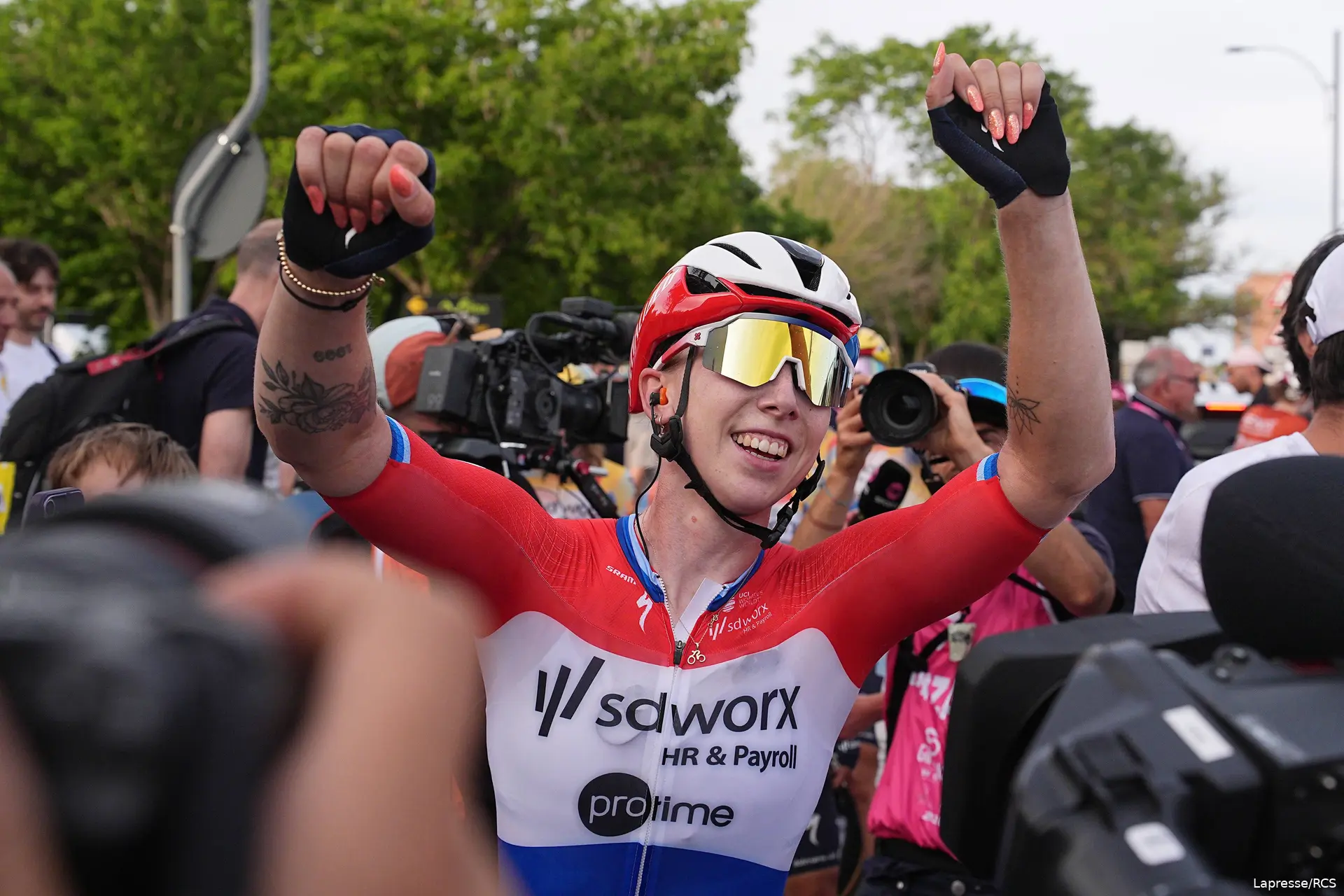
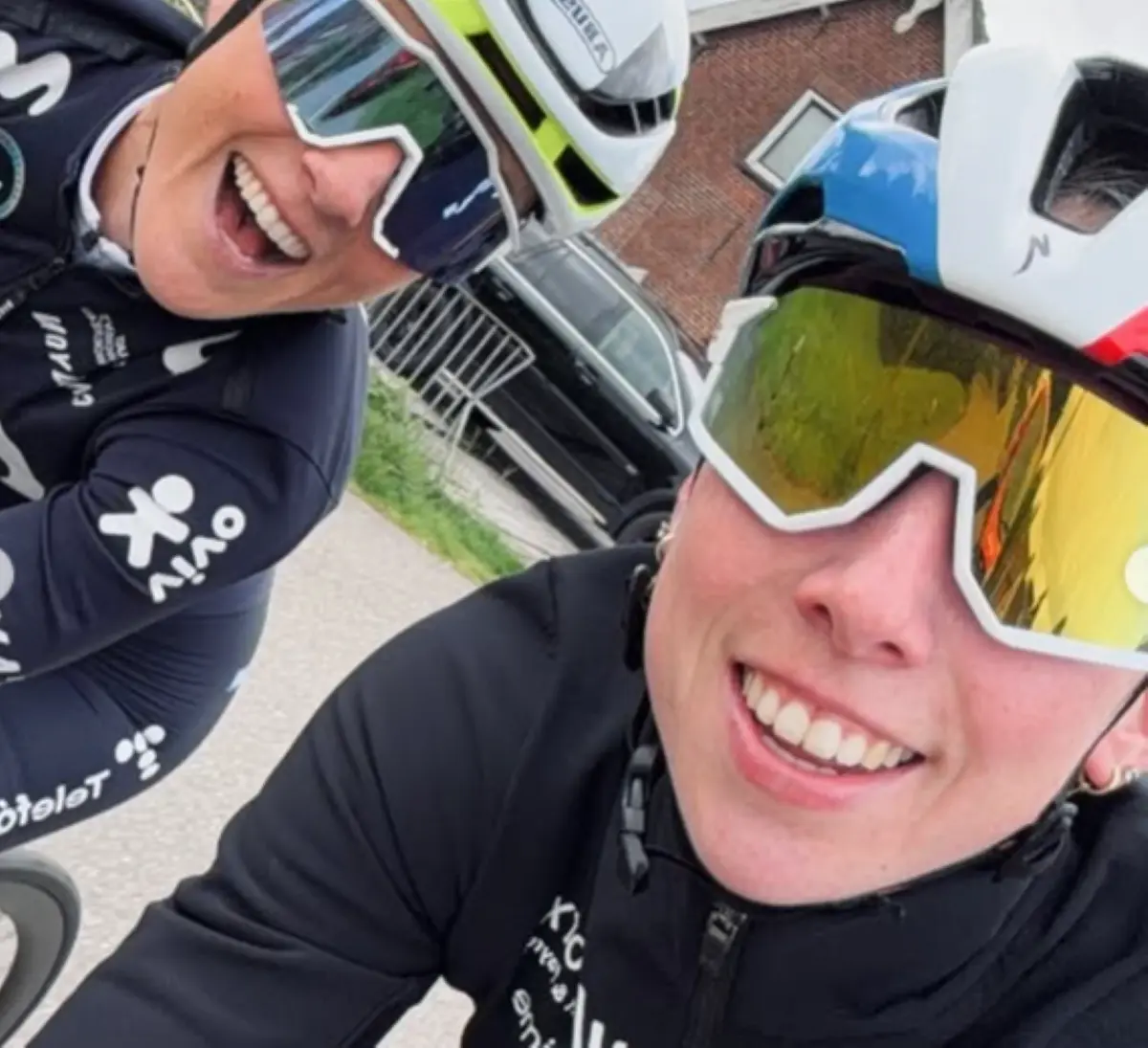
Follow us on GoogleLorena Wiebes’s story is by now well known. The Dutch sprint star was disqualified because her bike was too light, after sprinting convincingly to victory in stage one. On Thursday, however, Wiebes suddenly appeared by the roadside as a supporter, together with her friend and Movistar rider Floortje Mackaij. On the Dutch language podcast La Koers, Wiebes talks about the situation.
ADVERTISEMENT
At first Wiebes flew straight back after the disqualification, but once home she decided to travel back to Italy. “I still wanted to support the girls on the team. The evening of the decision was really tough, but then I saw my camper on the doorbell camera and thought: why shouldn’t I just go there?”
And so it happened. Wiebes drove her camper to the campsite where her friend Mackaij was also staying at the time. The Movistar rider had already reserved the spot, so the sprinter could blow off some steam by Lake Garda. The situation was very confusing for the Dutchwoman after her victory, she explains.
Continue reading below the photo!
Wiebes thought she would get a warning
“I came back from the podium ceremony and suddenly saw my bike still standing there. Then I thought: huh, that really can’t be right, can it? Then I heard my sports director say: ‘You’re not really going to throw her out of the Giro for this, are you?’ That was when I actually knew enough.” Wiebes, however, had not yet thought about a disqualification at all.
“At first you think they are going to take your pink jersey away. That would have been a shame too, but I could have lived with that.” On top of that, it initially seemed as though Wiebes would get away with a warning. “I still remember that they first said that if we could solve it before the next stages, then it would be fine.”
Continue reading below the photo!
Wiebes understands team's response to disqualification
That would have been no problem at all for the sprinter. “Even if they had put a kilo on it. The weight does not really matter to me anyway. I also sprinted with a full bidon on my bike,” she says with a laugh. But Wiebes and the team’s confusion lies in the weighing itself. “I saw the team weigh it and it was fine. It just cannot be that the team weighed it and did it wrong. I did try to put it behind me as quickly as possible, because I could not change it anymore,” she says.
Afterwards the team weighed it again and then it seemed to be fine. That was obviously a relief for the mechanics. “The mechanics naturally felt guilty, but I really had no anger towards them at all.” There was anger, but mainly towards the organisers. Her family felt it too. “My grandmother even called me to say she had lost sleep over it. She thought I would never be allowed to race again. Thankfully that is not the case,” she laughs.
She understands why her team is taking the matter to court. “I would definitely like the UCI to look at the regulations again. Whether the rider should really be punished so heavily for something the riders cannot do anything about. It also has nothing to do with safety. If I had ridden my sprint illegally, then I could still accept that, but now it feels very unfair. So I understand that the team is taking action, because otherwise it ends up on a pile and they just keep going,” she concludes.
Author: David Bavin-Hobbs - [email protected]
Read also
David Bavin-HobbsChief Editor
David has been working in the sports & cycling industry for 16 years. Covering racing, business and technology, he has worked in communications for cycling companies, teams, and as a journalist. His proudest achievement is winning the first bike race he ever entered. He hasn't won a race since.
IDL-productions
Team GB dominate, China on the rise, Lavreysen the best ever? Five takeaways from the 2026 Track World Championships
Track World Championships day 2: A golden day for Team GB, Levreysen goes 2 for 2, and Kopecky eliminates the competition
Rumours, speculation and guesswork: 2027 Tour de France route will be revealed live on October 22 in Paris
Vollering adds the Women’s European Championships road race jersey to her rainbow wardrobe
16-day Grand Tours, AI, VAR, drones and more: The UCI's new document has a potentially major impact from 2029 onwards
Latest Cycling News
Wiggins Jr. gets his call up to the Jayco AlUla WorldTour team, alongside 3 other emerging talents
No free live Tour de France for the UK until at least 2033, despite British Grand Départ in 2027
Young German talent leaves Red Bull-BORA-hansgrohe for more opportunities: 'I want to win again'
Greg LeMond on Pogačar, Seixas and living with cancer: 'He is the next Hinault'

Marcel Kittel, Wout van Aert, and Marianne Vos partied at a cycling festival in Ibiza: 'To avoid a major hangover'
Popular Cycling News
Marcel Kittel, Wout van Aert, and Marianne Vos partied at a cycling festival in Ibiza: 'To avoid a major hangover'
On the final race day of 2026, Tadej Pogacar reveals his goals for 2027
McNulty finally flies the rainbow flag and ends his season on a high at the Veneto Classic
Wiggins Jr. gets his call up to the Jayco AlUla WorldTour team, alongside 3 other emerging talents
Tom Pidcock pays special tribute to retiring brother Joey, but isn't totally happy: 'We had to settle for second place'
Latest Comments
- - The bike may be quick, but the article seems a bit too ready to credit the equipment for the result. Remco’s the one producing those watts—though I’ll admit, two minutes is a pretty convincing test ride.jennifer1918-10-2026
- - I’m still learning how time trials work: if Evenepoel caught Jay Vine, does that mean Vine started earlier, and do riders set off at fixed intervals?tourdeforce918-10-2026
- - A flat Tour TT on these roads would be brilliant viewing. Wide, fast courses really let the specialists show what they can do.davidm18-10-2026
- - Fourteen wins in a season is some going. He sounded focused on his own effort rather than the riders ahead, which is exactly the mindset you want in a race against the clock.michael5418-10-2026
- - Catching Vine and putting over two minutes into him is an enormous statement. That new Specialized clearly suits Remco—keen to see how it performs over a longer Tour time trial.raceready718-10-2026
- I’m still trying to understand the history here—why was insulin being used alongside amphetamines? Was that common in cycling at the time?cyclechamp4518-10-2026
- Hard to take the article’s “recovered” line at face value when it ends by raising concerns about team entourages. Cycling has made huge changes, but scrutiny still matters.velodromevirtuoso118-10-2026
- The detail about riders deliberately pushing him off the road is shocking. Do we know whether anyone ever faced consequences for that?pedalpowe2918-10-2026
- Bassons’ story is a grim reminder of what speaking up could cost in that era. Fair play to him for holding his ground when it meant being isolated by his own team.tourdeforce918-10-2026
- I’m still learning how team contracts work: if Barguil had ended his deal before 2018, could the team have left him out of the Tour, or was his place already agreed?sprocketspiny18-10-2026
Loading
