UAE responds to Rowe, Thomas and Zonneveld as Giro tyre choice questions increase after crashes on stages 2 and 5
Cycling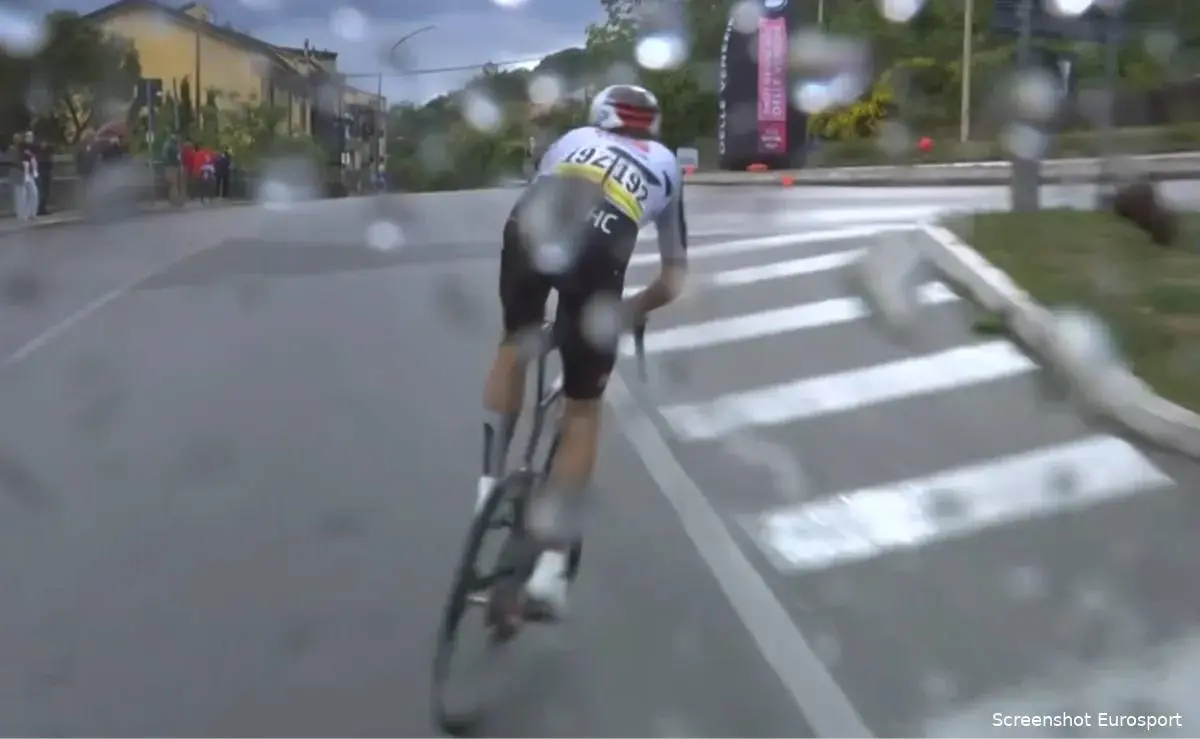
Follow IDL Pro Cycling on Google
Stay up to date with the best cycling news by making us a preferred source on Google.
Follow us on GoogleThe massive crash on stage 2 of the Giro d'Italia left UAE Team Emirates-XRG three riders before the race had even reached Italy. But beyond the wreckage, a question has been discussed by two former INEOS riders: should UAE have been riding time trial tyres in the wet?
ADVERTISEMENT
Marc Soler slid out at the head of the UAE train on a wet right-hand bend in Bulgaria, triggering a pile-up that also eliminated Jay Vine and Adam Yates. Vine left Bulgaria with a broken elbow and concussion. Soler sustained a pelvic fracture. Yates developed delayed concussion symptoms overnight and did not start stage 3.
In the aftermath, attention shifted — at least partly — to UAE's equipment choice.
'I really don't understand that decision'
On the Watts Occurring podcast, former riders, and current sports directors, Geraint Thomas and Luke Rowe discussed the topic directly.
"UAE were riding TT tyres," said Rowe. "We all know they're faster. They are faster. They always use them. They're the one team who use them under almost any circumstances — but they do have less grip. And the first guy down was a UAE guy. Lost both wheels."
Thomas admitted the issue was not unique to UAE. "It's been a bit of a topic in our team," he said. "We started using TT tyres, and then you use them more and more, and before you know it, it becomes standard. It's definitely something to consider — especially in Bulgaria, not knowing exactly how the roads are."
Rowe's frustration centred on one key detail: the rain was not a surprise.
"Was the rain a surprise? Were you on the ground — was it in the forecast?" he asked Thomas.
"No," Thomas replied. "It was forecast that it could be wet. All the boys knew."
Rowe's verdict was blunt. "I don't understand that decision. I really don't. A wet day and TT tyres — that seems like a strange call. And again, this is harsh to say, because half the team ended up on the deck.
UAE Emirates-XRG blames crashes on southern Italian road surfaces
IDL Pro Cycling was present with the UAE team on Wednesday, and we put the question of Arrieta's crashes — and the team's explanation for them — to sporting director and former professional Marco Marcato. Tyres? Marcato shook his head. "This is normal — especially on a day when it barely stopped raining."
That Arrieta almost lost his rear wheel even on a flat section of tarmac, the Italian directeur sportif explained differently: "In southern Italy, when it hasn't rained for a while and suddenly there's heavy rainfall, the roads here are extremely slippery. We also warned the riders about it in this morning's meeting — that the road surfaces in this region can be especially slick."

Zonneveld: UAE Emirates-XRG partly to blame for their Giro crashes
There is no doubt that time trial tyres are fast and supple. "Riders feel like they're flying," said Dutch journalist and former pro Thijs Zonneveld — who also saw riders struggling with the lack of grip in the wet. And so he considers the crashes, particularly on stage two, "partly attributable" to that choice.
"There are more teams that prioritise making their equipment as fast as possible over making it as safe as possible," he said. "The manufacturer doesn't expect a team to use these tyres in road races. And using them on a wet day — that's on a completely different level. But I've asked around at several teams and they confirm UAE are using them at this Giro."
"Tadej Pogacar rides them almost all the time. And when he does it, everyone wants to." But when riders from other teams are the ones paying the price, Zonneveld believes a line needs to be drawn. "I think a team like UAE could easily make it easier for others — that's not fair, but it is the reality. If I were a rider at another team, I'd say something about it at some point. They put themselves at risk — but in stage two, they also took out ten riders from other teams."
Are UAE Team Emirates using time trial tyres at the Giro?
Zonneveld was sharply critical on his podcast when the conversation turned to UAE's crashes at stage 2 and stage 5 at this year's Giro. "Yes, it was incredibly slippery, and I think both Arrieta and Eulalio took risks on the descents. They are good bike handlers — but UAE very often ride on Continental time trial tyres, and they're doing it at this Giro too."
IDL Pro Cycling can confirm the Continental Grand Prix 5000 tyres were indeed visible on the bikes strapped to the roof of the UAE team car after stage five. According to Zonneveld, that is simply not acceptable on wet days like Wednesday. "In stage two as well, the heavy crash began with a UAE rider losing his grip. And you saw exactly the same thing with Arrieta."
The art of timing.
— Giro d'Italia (@giroditalia) May 13, 2026
💥 Igor Arrieta crashed in the downhill, and 🇵🇹 Afonso Eulalio is flying towards his first ever win!
📺 Follow the #Giroditalia on TV, and on socials, wherever you are 🌐 https://t.co/g9d70eoLtw pic.twitter.com/tKRybkcu4T
What are TT tyres — and why are they dangerous in the wet?
On a normal road stage, most riders use all-round tyres: built for a balance of speed, grip and durability across different conditions. TT — or time trial — tyres are different. They are built purely for speed. Narrower, run at higher pressure, and with a smoother surface and minimal tread, they reduce rolling resistance and aerodynamic drag.
In dry conditions, that trade-off is worth making. In the wet, Luke Rowe would argue, it is not.
Grip depends on a tyre's ability to maintain contact with the road. In wet conditions, water sits between the tyre and the tarmac. A tread pattern channels that water away and preserves grip. A smooth TT tyre cannot do that. Higher pressure makes things worse — it reduces the surface area in contact with the road at precisely the moment when you need the most traction.
On a wet descent at race speed, the margin for error disappears very quickly.
Risk versus reward
UAE's willingness to push the boundaries on equipment is well documented, and in dry conditions, faster tyres can be decisive.
Thomas framed the broader dilemma thoughtfully. "Risk versus reward — what route do you go down? The Giro compared to the Tour is a bit different. The Tour generally has better-quality roads." Bulgaria, by contrast, was unknown territory for the professional peloton.
Neither Thomas nor Rowe suggest UAE acted with reckless disregard. Both acknowledged it is a judgement call that every team faces. But when the rain was forecast, and the roads unknown, that calculation looks harder to defend.
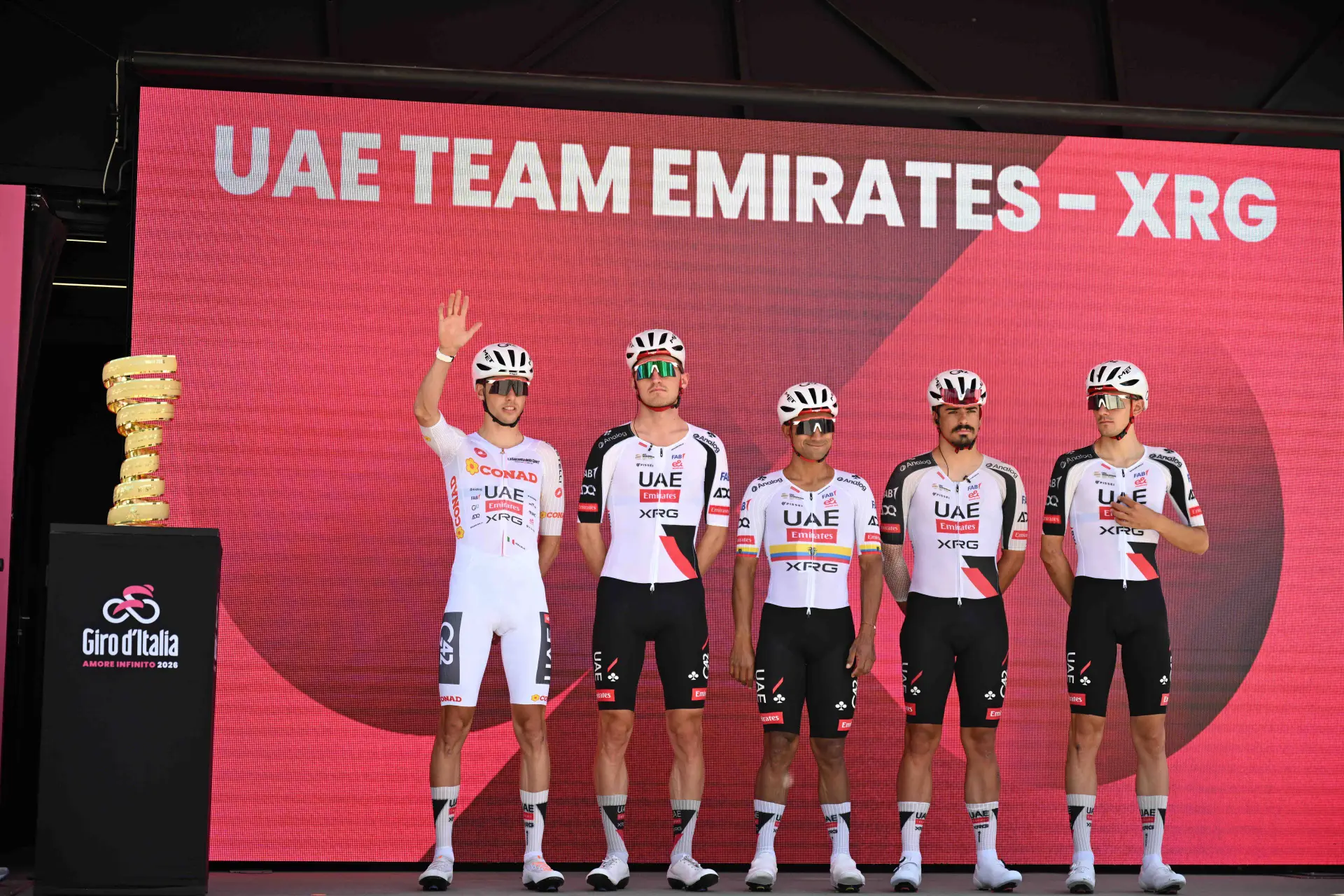
With three of their own riders sent home before the race reached Italian soil, and many other teams effected, those questions may come back to haunt the team.
David Bavin-HobbsChief Editor
David has been working in the sports & cycling industry for 16 years. Covering racing, business and technology, he has worked in communications for cycling companies, teams, and as a journalist. His proudest achievement is winning the first bike race he ever entered. He hasn't won a race since.
IDL-productions
Rumours, speculation and guesswork: 2027 Tour de France route will be revealed live on October 22 in Paris
Vollering adds the Women’s European Championships road race jersey to her rainbow wardrobe
16-day Grand Tours, AI, VAR, drones and more: The UCI's new document has a potentially major impact from 2029 onwards
Quinn Simmons' Strava shows exactly what it takes to compete at the World Championships: ‘I said, Hey guys, anything is possible'
Despite losing the World Championships, Del Toro and Seixas rank high mentally and physically on the Pogačar scale
Latest Cycling News
Marc Reef explains why his Visma | Lease a Bike is a good option for Paul Seixas

'Encouraging neurological recovery' for severely injured American cyclist
Quinn Simmons doesn't hold back after his coach leaves Lidl-Tek: 'Lost one of the good ones'
Primož Roglič reacts to winning European title in front of his home crowd: 'I just went with my instincts!'
Giro d'Italia 2027 teases route ahead of official reveal: Slovenia and return of iconic climb both on the menu
Popular Cycling News

Lance Armstrong was diagnosed with cancer 30 years ago but is still here today; celebrates with wife Anna Hansen
European Championship organiser answers Giulio Ciccone's photo finish complaint: 'In the case of minimal differences'
Ciccone casts doubt on European Championship photo finish with Remco Evenepoel: 'I'm asking for something very simple'
Sensational Primož Roglič gives home fans something to cheer about by winning the mens' European time trial title
Lidl-Trek terminate multiple contracts, lucrative transfer season in full swing at German team
Latest Comments
- Great drama, but the article leans a little too hard into the “what if” angle. Evenepoel still had to recover from a crash and finish the job—credit where it’s due.robert6507-10-2026
- What exactly is a pacer in this situation, and why was Ciccone listening to that information instead of just watching the race? I’m still learning the tactics, but it seems like Scaroni being behind changed everything.andrewf07-10-2026
- The photo finish sounds far too vulnerable to tiny setup errors. If the line is curved and the camera alignment is even slightly off, can we really call a one-pixel victory completely definitive?jennifer1907-10-2026
- Ciccone’s final turn was excellent, but I agree with Zonneveld that he probably worked too much before the finish. With Scaroni behind, sitting on Remco’s wheel would have been the smarter gamble.bikebuffj07-10-2026
- Evenepoel showed serious resilience after that crash. Coming back, attacking on the descent and still winning the sprint is a proper champion’s performance.cadencekingm07-10-2026
- I’m still learning the sport—if Del Toro is the defending champion, why would McNulty be the leader instead? And does winning Gran Piemonte usually show whether a rider is fit enough for Il Lombardia?cadencekingm07-10-2026
- Matthews was gracious on the podium, then clearly had more to say afterwards. Hopefully the racing answers the questions rather than more team-manager statements about “data”. Great preview overall, though the Lombardia start-list speculation feels a bit premature.robert6507-10-2026
- The UAE selection is intriguing. Del Toro wearing number one doesn’t necessarily mean he’s the protected leader, but if he wins again the Montréal debate will only get louder. Bring on Thursday!cyclechamp4507-10-2026
- What a line-up for Gran Piemonte. McNulty, Matthews and Del Toro racing together again should make the finale fascinating, especially with that 8% ramp inside the final 1,500 metres. Matthews has every reason to fancy his chances.gearguru3307-10-2026
- - Super hyped for Leeds start for the Femmes. London TTT near the landmarks will be epic telly. Bonne chance à toutes, allez allez!sprocketspiny06-10-2026
Loading